This makes me really sad--I know that these types of mass shootings can be stopped if someone would pay attention. Note that the shooter is a female.
Update: Of course, this is a surprise--who could have guessed that this woman was irrational for years?
Tuesday, January 31, 2006

Another Anti-Republican Study
Well, it's about time for another absurd psychological study looking at the racism of guess who--I know you will be shocked--Republicans--hat tip Michelle Malkin. Take a look at this Washington Post article about a study that ties political leanings to hidden biases:
and the study goes on to say:
Here is the test the biased liberals--I mean "reseachers"-- used to make their point. It has been around for awhile but I have never taken it until today after seeing this silly article. My results are quite interesting. The first time I took the test, my results said that I had a moderate preference for European Americans to African Americans. I took the test a second time and it said I had a slight preference for African Americans over European Americans. Well, which is it?
The test takes a bit of time--try it for yourself. But I remain a skeptic of this silly biased test--especially since the researchers are giving money to the Democratic Party--including Howard Dean. Doesn't that fact tell you all you need to know about the reliability and validity of their "unbiased" research? And where is any research done by conservative psychologists about liberals? Or is conservative and psychologist an oxymoron?
I also find the researchers conclusions about implicit tests to be laughable. They make the assumption that those with implicit or implied bias would be prejudiced in everyday life. One set of researchers at MIT and the University of Chicago did a study where they sent out the exact same resume to potential employers using a white or a black name. The whites got 50% more call backs. Wow, what a scientific study. I did my own similar scientific study in the late 80's. A good friend of mine in Manhattan was trying to get into a PHD program in clinical psychology. These programs are extremely competitive and hard to get into--sometimes with over 600 applicants and 10 openings. Needless to say, my friend was devastated when she was turned down by every program. She came to me in tears before sending out her next set of applications and asked me what to do to get in. I took a look at her 3.7 grade average from NYU and impeccable credentials and told her to leave everything the same and change her name from her English sounding one to her married name of Gonzalez and mail out the applications. She did and next thing you know, she was swamped with interviews. The only problem? Once they saw her white face, they quickly lost interest. The moral of my little unscientific study? We can all come up with results that match our world views if we try hard enough.
Another study presented at the conference, which was in Palm Springs, Calif., explored relationships between racial bias and political affiliation by analyzing self-reported beliefs, voting patterns and the results of psychological tests that measure implicit attitudes -- subtle stereotypes people hold about various groups.
That study found that supporters of President Bush and other conservatives had stronger self-admitted and implicit biases against blacks than liberals did.
"What automatic biases reveal is that while we have the feeling we are living up to our values, that feeling may not be right," said University of Virginia psychologist Brian Nosek, who helped conduct the race analysis. "We are not aware of everything that causes our behavior, even things in our own lives."
and the study goes on to say:
For their study, Nosek, Banaji and social psychologist Erik Thompson culled self-acknowledged views about blacks from nearly 130,000 whites, who volunteered online to participate in a widely used test of racial bias that measures the speed of people's associations between black or white faces and positive or negative words. The researchers examined correlations between explicit and implicit attitudes and voting behavior in all 435 congressional districts.
The analysis found that substantial majorities of Americans, liberals and conservatives, found it more difficult to associate black faces with positive concepts than white faces -- evidence of implicit bias. But districts that registered higher levels of bias systematically produced more votes for Bush.
Here is the test the biased liberals--I mean "reseachers"-- used to make their point. It has been around for awhile but I have never taken it until today after seeing this silly article. My results are quite interesting. The first time I took the test, my results said that I had a moderate preference for European Americans to African Americans. I took the test a second time and it said I had a slight preference for African Americans over European Americans. Well, which is it?
The test takes a bit of time--try it for yourself. But I remain a skeptic of this silly biased test--especially since the researchers are giving money to the Democratic Party--including Howard Dean. Doesn't that fact tell you all you need to know about the reliability and validity of their "unbiased" research? And where is any research done by conservative psychologists about liberals? Or is conservative and psychologist an oxymoron?
I also find the researchers conclusions about implicit tests to be laughable. They make the assumption that those with implicit or implied bias would be prejudiced in everyday life. One set of researchers at MIT and the University of Chicago did a study where they sent out the exact same resume to potential employers using a white or a black name. The whites got 50% more call backs. Wow, what a scientific study. I did my own similar scientific study in the late 80's. A good friend of mine in Manhattan was trying to get into a PHD program in clinical psychology. These programs are extremely competitive and hard to get into--sometimes with over 600 applicants and 10 openings. Needless to say, my friend was devastated when she was turned down by every program. She came to me in tears before sending out her next set of applications and asked me what to do to get in. I took a look at her 3.7 grade average from NYU and impeccable credentials and told her to leave everything the same and change her name from her English sounding one to her married name of Gonzalez and mail out the applications. She did and next thing you know, she was swamped with interviews. The only problem? Once they saw her white face, they quickly lost interest. The moral of my little unscientific study? We can all come up with results that match our world views if we try hard enough.
5th Carnival of Homeschooling
The 5th Carnival of Homeschooling is up and is being hosted by Palmtree Pundit who resides in Hawaii. Go check it out.
Monday, January 30, 2006
Podcast on Boys, Education and Hybrid Cars


We are talking today to Michael Gurian, the author of, The Minds of Boys : Saving Our Sons From Falling Behind in School and Life.
 If you have a boy, are a boy or care about boys, take a listen and gain more information from this expert on the minds of boys. We also have Jim Miegs, the editor of Popular Mechanics, giving us the lowdown on hybrid cars--are they hype or happening? You can listen to the podcast by clicking here.
As always, any comments or suggestions are welcome.
Update: Here is more on hybrid cars at Popular Mechanics.
Self-Made Sexist
Leave it to a woman at the Guardian to provide a sexist description of how she views being a man. In response to Norah Vincent's Self-Made Man, this is how the reviewer says she would act as a male:
Lady, you must be one hell of a feminist.
Maybe that's why male-me would just give up trying to be great and succumb (with regret) to being arrogant, chauvinistic-appalling and subsequently having a whale of a time. I'd have the big red 'compensating' car, the smarmy chat-up lines, the commitment-phobia. I'd love 'em and leave 'em and, if it comes to it, pretend I never met 'em. I'd come home to my wife stinking of perfume, with my trousers covered in grass stains, and tell her off for being 'paranoid'. I'd trample on colleagues ruthlessly and swagger around the office like the undiscovered Donald Trump. I'd read Nuts on the loo because 'I like the articles'. And there you go. Not only does masculinity suddenly look a lot easier, it also looks a lot more fun. Odd to think, though, that women who are feminists might be more likely to become men who are chauvinists.
Lady, you must be one hell of a feminist.
Sunday, January 29, 2006
Don't Call Me Grandma
Does anyone want to stay with the kids anymore? In this Newsweek article, there is mention that 40% of boys are being raised without their father. Now, this MSN article says that not only do grandmothers not want to be called Grandma but they are making their grandkids pencil in appointments to see them! The father issue is very important and one that needs to be addressed. But, in addition to fathers being absent, it seems that no one in the extended family wants to hang out with kids anymore--including grandmothers:
Wow, this woman puts her grandkids in the same category as buying an investment property in Oregon. It's no wonder that kids don't know how to deal with simple human relationships. Here is another grandmother from the same MSN article discussing her feelings about her grandkids, "I love those little kids and I do want to have a relationship with them," she said. "But I'm not willing to give up my writing or my traveling. I'll be the best grandmother I can from a distance."
Yep, better not get to close to the grandkids--they might actually want to see you. As extended families become less influential in children's lives, I can't help but think this must affect their ability to learn about the closeness of human interactions. Perhaps the only lesson they take away is that they are just one more chore added to a too-do list and even there, they come up short. Add to this the guilt parents feel about not spending enough time with kids themselves and the never ending material goods being lavished on the little darlings and it's no wonder kids can be confused and unclear about the importance of human interactions. Extended family also gives kids examples of how other people behave outside of the daycare, school or their immediate family. Grandparents don't have to go overboard but perhaps not adding the grandkids to the to-do list but rather to the I-would-love-to see-them list would be a start.
Update: Just for the record, for my extended family, particularly the grandparents--please disregard the above--all of you are terrific grandparents who are generous with your time and love for your grandkids, despite your busy schedules.
Look, I'd love to nip over and whisper secrets into 1-month-old Maggie's ears, or to dress 2-year-old Ryan in the black leather jacket I bought her recently and take her to look for late blackberries in Golden Gate Park on my bike (with its deluxe new kid seat). But I have a job. I'm a reporter, I have two books to write, a husband who wants to go to France, and I just bought an investment property in Portland, Oregon. I love my grandchildren, but being a grandmother got added to my to-do list.
Wow, this woman puts her grandkids in the same category as buying an investment property in Oregon. It's no wonder that kids don't know how to deal with simple human relationships. Here is another grandmother from the same MSN article discussing her feelings about her grandkids, "I love those little kids and I do want to have a relationship with them," she said. "But I'm not willing to give up my writing or my traveling. I'll be the best grandmother I can from a distance."
Yep, better not get to close to the grandkids--they might actually want to see you. As extended families become less influential in children's lives, I can't help but think this must affect their ability to learn about the closeness of human interactions. Perhaps the only lesson they take away is that they are just one more chore added to a too-do list and even there, they come up short. Add to this the guilt parents feel about not spending enough time with kids themselves and the never ending material goods being lavished on the little darlings and it's no wonder kids can be confused and unclear about the importance of human interactions. Extended family also gives kids examples of how other people behave outside of the daycare, school or their immediate family. Grandparents don't have to go overboard but perhaps not adding the grandkids to the to-do list but rather to the I-would-love-to see-them list would be a start.
Update: Just for the record, for my extended family, particularly the grandparents--please disregard the above--all of you are terrific grandparents who are generous with your time and love for your grandkids, despite your busy schedules.
Saturday, January 28, 2006
Simple Rules for Making an Idiot of Yourself on the Internet
I find it hard to believe that John Kerry is posting at the Daily Kos. Perhaps Kerry could use some more tips from the hilarious James Lileks who states:
Read the whole thing.
Update: Now Ted Kennedy is posting over at the Daily Kos via Michelle Malkin--does the Senator have any scruples at all? Oh wait, what am I saying?
Ever since Bush imposed martial law and shot the cast of "The View" -- sorry, since Bush won the last election, hard-left nuttery seems more mainstream. Bob Dole did not post on bulletin boards that claimed Bill Clinton would soon use FEMA to herd everyone into U.N.-run camps where everyone would get Mark of the Beast bar codes on their necks. John Kerry, on the other hand, has posted at the Daily Kos, whose neck-vein-popping contributors seem to think Bush spends his nights getting hammered and ordering Halliburton to poison Iraqi water so he can get kickbacks from the Pepto-Bismol Crime Syndicate.
Read the whole thing.
Update: Now Ted Kennedy is posting over at the Daily Kos via Michelle Malkin--does the Senator have any scruples at all? Oh wait, what am I saying?
Attitude Problem
Have you ever seen traits in yourself that come back to haunt you in your kid? Of course, most of us have. I attended a parent/teacher meeting yesterday for my daughter at her elementary school and the dreaded "attitude problem" reared its head. "Your child is very intelligent," said one teacher,"but she rolls her eyes at us like she thinks we are idiots." As I hear this, my own mind floats back over thirty years to first grade where I cursed a teacher for giving us too much homework--I kept this little tidbit to myself but thought about how much genetics plays a part in our dispositions. I used to think my rebelliousness was purely a response to my socialization as a kid, but now I see it is more than that. So my kid is just like me--now what?
I think the key here is "what do you do with characteristics that society says are undesirable at times, but that are part of your psychological make-up and integral to who you are?" I remember once my MMPI results showed that I had a high degree of hostility towards authority but no other "negative" traits. Is this hostility towards authority such a bad thing--especially if someone in authority is an idiot? I am not sure questioning some authority figures is so bad but there are more appropriate ways of dealing with this feeling than cursing at a teacher or rolling one's eyes when annoyed. I learned over the years to downplay my outright contempt for others as best I could and I turned my anger into a job working with others with the same "authority problems."
When kids or adults come into my office looking exasperated with "the system" whether that be school, work or society, they generally find a kindred spirit in me. The difference is that I teach them to sublimate their anger or hostility into something more positive or at least not dangerous. So the kid who threatens teachers, caregivers and others learns to channel their anger into working with computers and the adult who feels angry with the system learns to become a political advocate etc. There are always positive ways to channel the energy of anger, rebelliousness, or anti-authoritarianism that can help the individual live a better life and to benefit society.
Anyone else have what society would see as less than desirable traits in themselves that they see in their children and if so, how are you coping with it?
I think the key here is "what do you do with characteristics that society says are undesirable at times, but that are part of your psychological make-up and integral to who you are?" I remember once my MMPI results showed that I had a high degree of hostility towards authority but no other "negative" traits. Is this hostility towards authority such a bad thing--especially if someone in authority is an idiot? I am not sure questioning some authority figures is so bad but there are more appropriate ways of dealing with this feeling than cursing at a teacher or rolling one's eyes when annoyed. I learned over the years to downplay my outright contempt for others as best I could and I turned my anger into a job working with others with the same "authority problems."
When kids or adults come into my office looking exasperated with "the system" whether that be school, work or society, they generally find a kindred spirit in me. The difference is that I teach them to sublimate their anger or hostility into something more positive or at least not dangerous. So the kid who threatens teachers, caregivers and others learns to channel their anger into working with computers and the adult who feels angry with the system learns to become a political advocate etc. There are always positive ways to channel the energy of anger, rebelliousness, or anti-authoritarianism that can help the individual live a better life and to benefit society.
Anyone else have what society would see as less than desirable traits in themselves that they see in their children and if so, how are you coping with it?
Thursday, January 26, 2006
Hey Buddy, Pass the Glitter
Thanks to reader DRJ for pointing out this article in the Boston Globe about a 17-year-old boy, Doug Anglin, and his father, who have filed a federal civil rights complaint against Milton High School for bias against boys. Even the student body president agrees that there are problems for boys in the high school:
This reminds me of an education class I was forced to take as a requirement for my PHD degree in school/clinical psychology. The professor--a male--told us to keep a log of our activities with students or patients in my case on notebook paper and turn them in for a portion of our grade. I was out for the class when the instructions were given so got the assignment second-hand from other students. I was shocked when I received an F on the assignment--the reason? Writing outside the margins of my paper. The professor cared nothing about the content I had so carefully written out as best I could--he only cared about appearances. I can only imagine what the boys in this high school are going through with such prissy teachers.
Update: Dr. Tony has more thoughts on "boys behaving badly."
Anglin's complaint has set off a buzz among the 1,000 students at the school. Little, the student body president, said she disagrees with students who think Anglin is chauvinistic.
Of the 22 students in her honors Spanish class, only one is a boy, said Little, a senior. She also said that teachers rarely ask her for a hall pass if she is not in class, while they routinely question boys walking behind her.
As for assignments, she said, one teacher expects students to type up class notes and decorate their notebooks with glitter and feathers.
''You can't expect a boy to buy pink paper and frills to decorate their notebooks," Little said.
This reminds me of an education class I was forced to take as a requirement for my PHD degree in school/clinical psychology. The professor--a male--told us to keep a log of our activities with students or patients in my case on notebook paper and turn them in for a portion of our grade. I was out for the class when the instructions were given so got the assignment second-hand from other students. I was shocked when I received an F on the assignment--the reason? Writing outside the margins of my paper. The professor cared nothing about the content I had so carefully written out as best I could--he only cared about appearances. I can only imagine what the boys in this high school are going through with such prissy teachers.
Update: Dr. Tony has more thoughts on "boys behaving badly."
Fourth Homeschooling Blog Carnival
The Fourth Homeschooling Blog Carnival is up--hosted this time by The Common Room Blog. Go check it out.
Wednesday, January 25, 2006
Podcast Interview with Norah Vincent

Here is our podcast interview with Nora Vincent, the author of Self-Made Man : One Woman's Journey into Manhood and Back.
 Norah talks about living as Ned, why boys need fathers, and the next stage of feminism. You can listen to the podcast by clicking here (you don't need an iPod!) or you can listen on iTunes by clicking here.
There's some very cool music by Audra and the Antidote -- check out the words to the opening tune. Hope you like it, and if you have any comments, let me know.
I don't mean to sound like Oprah but you must read this book!
Now Here is a True Psychological Test
I'm a Dodge Viper!

You're all about raw power. You're tough, you're loud, and you don't take crap from anyone. Leave finesse to the other cars, the ones eating your dust.
Take the Which Sports Car Are You? quiz.
Tuesday, January 24, 2006
Go Red for Women
I spent the day helping our local tv show, Style, with a story on women and heart disease. If you would like to see the video of the show that tells what happened during my heart attack and to learn more about women's symptoms of a heart attack, see the story here at WBIR.
Conservababe calender
Wow--what an honor to be chosen as one of the "Conservababes" by Right Wing News--I guess I would be the May calender woman. Just one problem--I am not really a conservative--unless supporting the war automatically makes one a conservative. I am an independent/libertarian and would probably be an anarchist if left to my own devices.
Medical Grand Rounds
Medical Grand Rounds is up and is being hosted by Kevin, M.D. My medical psychosis post is there so I am hoping that some of the medical personnel who read Grand Rounds will have a little more mercy on those of us who have fears about going in for medical procedures.
Monday, January 23, 2006
Boys are Just "Defective Girls"
Newsweek has an article this week on the boy crisis, which examines how boys are failing in school. Boys are not only doing poorly, they feel poorly about school: The number of boys who said they didn't like school rose 71 percent between 1980 and 2001. I found the last paragraph of the article the most important:
Doesn't this last line sound just like what we used to tell girls over twenty years ago? "Girls can be as good as boys", we drilled into kid's heads in the 1970's and 80's--in fact, girls were told that they were better and most of them now believe it (or at least fake it). Are we so angry that girls got the shaft twenty or more years ago that we are willing to sacrifice the education of innocent young boys today to make up for that wrong?
Update: Michal Gurian, who is mentioned in the Newsweek article is the author of, The Minds of Boys : Saving Our Sons From Falling Behind in School and Life.He will be joining us for a podcast next week on the topic of the disconnect between boys and the classroom. If you have a pressing question for Mr. Gurian, leave it in the comment section and I will choose a couple to ask him--thanks!
For Nikolas Arnold, 15, a sophomore at a public high school in Santa Monica, Calif., college is a distant dream. Nikolas is smart: he's got an encyclopedic knowledge of weaponry and war. When he was in first grade, his principal told his mother he was too immature and needed ADHD drugs. His mother balked. "Too immature?" says Diane Arnold, a widow. "He was six and a half!" He's always been an advanced reader, but his grades are erratic. Last semester, when his English teacher assigned two girls' favorites—"Memoirs of a Geisha" and "The Secret Life of Bees" Nikolas got a D. But lately, he has a math teacher he likes and is getting excited about numbers. He's reserved in class sometimes. But now that he's more engaged, his grades are improving slightly and his mother, who's pushing college, is hopeful he will begin to hit his stride. Girls get A's and B's on their report cards, she tells him, but that doesn't mean boys can't do it, too.
Doesn't this last line sound just like what we used to tell girls over twenty years ago? "Girls can be as good as boys", we drilled into kid's heads in the 1970's and 80's--in fact, girls were told that they were better and most of them now believe it (or at least fake it). Are we so angry that girls got the shaft twenty or more years ago that we are willing to sacrifice the education of innocent young boys today to make up for that wrong?
Update: Michal Gurian, who is mentioned in the Newsweek article is the author of, The Minds of Boys : Saving Our Sons From Falling Behind in School and Life.
He will be joining us for a podcast next week on the topic of the disconnect between boys and the classroom. If you have a pressing question for Mr. Gurian, leave it in the comment section and I will choose a couple to ask him--thanks!
Sunday, January 22, 2006
Condi's Childhood
I am a big admirer of Condi Rice, not just for her success as Secretary of State, but because she made it despite the obstacles of growing up as an African American in the South. But rather than wasting their time whining and despairing over their victimhood as minorities, Condi's parents took action to ensure that their child would succeed. In Dick Morris's book, Condi vs. Hillary : The Next Great Presidential Race, Morris decribes Condi's childhood and shows us why she could be a great president.
Not long after Rosa Parks refused to give up her bus seat but prior to President Johnson signing the 1964 Civil Rights Act into law, Condi's mother showed her daughter how to stand up to racism. While shopping as a young girl with her mother at a local department store, an employee told them that they could not use the "whites only" dressing room and would have to try on their clothes in the back storage closet. Condi's mother refused and the employee relented and let them use the dressing room, all the while worrying that she would lose her job for doing so. On another trip, a white saleswomen told seven-year-old Condi to get her hands off a hat--her mother encouraged her to touch every hat in the store. Condi's lesson--people can tell you what to do but you don't have to listen.
After the 1963 Sixteenth Street Baptist Church bombing which took the lives of four little girls--two of whom Condi knew personally--Condi learned that Birmingham was not a safe place. She also learned how brave her father was when he armed himself with a shotgun and joined other men in the black community in night patrols to keep the Ku Klux Klan out of their neighborhood. But rather than let fear overtake her and make her feel like a victim, she instead learned an important lesson--the value of the Second Amendment guarantee of the "right to bear arms".
Morris's book points out that Condi was "entirely focused on individual self-improvement. She never ran for any office in school and remained separate and apart, a prodigy who mastered every manner of musical instrument. ...The Rice family did not need a hand out or a hand up. Condi would move ahead on her own."
I think this independence is what liberals hate about Condi Rice. She represents a woman who does not need them or their slogan of victimhood. This drives them crazy--so much so that they even look past her fairly moderate stance on abortion and the fact that she is an African American female who would make an amazing president.
Morris decribes Condi's childhood and shows us why she could be a great president. Not long after Rosa Parks refused to give up her bus seat but prior to President Johnson signing the 1964 Civil Rights Act into law, Condi's mother showed her daughter how to stand up to racism. While shopping as a young girl with her mother at a local department store, an employee told them that they could not use the "whites only" dressing room and would have to try on their clothes in the back storage closet. Condi's mother refused and the employee relented and let them use the dressing room, all the while worrying that she would lose her job for doing so. On another trip, a white saleswomen told seven-year-old Condi to get her hands off a hat--her mother encouraged her to touch every hat in the store. Condi's lesson--people can tell you what to do but you don't have to listen.
After the 1963 Sixteenth Street Baptist Church bombing which took the lives of four little girls--two of whom Condi knew personally--Condi learned that Birmingham was not a safe place. She also learned how brave her father was when he armed himself with a shotgun and joined other men in the black community in night patrols to keep the Ku Klux Klan out of their neighborhood. But rather than let fear overtake her and make her feel like a victim, she instead learned an important lesson--the value of the Second Amendment guarantee of the "right to bear arms".
Morris's book points out that Condi was "entirely focused on individual self-improvement. She never ran for any office in school and remained separate and apart, a prodigy who mastered every manner of musical instrument. ...The Rice family did not need a hand out or a hand up. Condi would move ahead on her own."
I think this independence is what liberals hate about Condi Rice. She represents a woman who does not need them or their slogan of victimhood. This drives them crazy--so much so that they even look past her fairly moderate stance on abortion and the fact that she is an African American female who would make an amazing president.
Saturday, January 21, 2006
Medical Psychosis
I have to admit--I am afraid to go to the doctor. I have always hated hospitals--they seemed so depressing and scary--which is why I have a PhD and not an MD; I figured fainting at the sight of blood would probably be a bad quality in a doctor. While I am over the fainting at blood part, (you get used to all the blood drawing when you have heart problems) just the thought of going to a medical facility starts my heart palpitating. Yesterday, it was time for another three month check-up of my ICD. My check up was with a heart rhythm specialist who does an interrogation of my cardiac device by hooking me up to a computer and running a magnet over my chest to control the defibrillator. Somehow, just the thought of someone else being able to control my heart is enough to send me over the edge.
In preparation for my appointment, I packed an interesting book, bottled water and some food to calm my nerves after it was over. However, I found that nothing could distract me once the doctor started talking. I can usually interpret with fair accuracy what my own clients are trying to tell me but my translation of what a doctor is saying about my medical condition is so far off the mark, I sometimes wonder if a diagnosis of "medical psychosis" should be added to my chart. My translation goes something like this:
Doctor: Hi, I'm Dr. so and so, nice to meet you.
My Translation: I'm here to give you your last rites.
Doctor: Your potassium is a little low.
My Translation: You're lucky your heart is beating at all.
Doctor: Your heart is beating a little fast, are you nervous?
My Translation: Your heart is pounding out of your skin, you'll be lucky to make it out of this office without a major heart attack.
Doctor: Did you have a nice Christmas Holiday?
My Translation: You're damn lucky you made it to Christmas.
Doctor: We're going to try some new meds.
My Translation: Lord knows, the old meds weren't working--it's amazing you made it into the office without a gurney.
Doctor: Well, we're all done, see you in six months!
My Translation: Sucker! You'll be lucky if you make it three.
Well, you get the idea. For my next appointment, I think I'll bring a tape recorder so I can actually hear what the doctor said!
Update: Shrinkette has more on why it might be risky for doctors to reassure patients.
In preparation for my appointment, I packed an interesting book, bottled water and some food to calm my nerves after it was over. However, I found that nothing could distract me once the doctor started talking. I can usually interpret with fair accuracy what my own clients are trying to tell me but my translation of what a doctor is saying about my medical condition is so far off the mark, I sometimes wonder if a diagnosis of "medical psychosis" should be added to my chart. My translation goes something like this:
Doctor: Hi, I'm Dr. so and so, nice to meet you.
My Translation: I'm here to give you your last rites.
Doctor: Your potassium is a little low.
My Translation: You're lucky your heart is beating at all.
Doctor: Your heart is beating a little fast, are you nervous?
My Translation: Your heart is pounding out of your skin, you'll be lucky to make it out of this office without a major heart attack.
Doctor: Did you have a nice Christmas Holiday?
My Translation: You're damn lucky you made it to Christmas.
Doctor: We're going to try some new meds.
My Translation: Lord knows, the old meds weren't working--it's amazing you made it into the office without a gurney.
Doctor: Well, we're all done, see you in six months!
My Translation: Sucker! You'll be lucky if you make it three.
Well, you get the idea. For my next appointment, I think I'll bring a tape recorder so I can actually hear what the doctor said!
Update: Shrinkette has more on why it might be risky for doctors to reassure patients.
Friday, January 20, 2006
It's Another Podcast!

Worried about Iran and nuclear weapons? Maybe you should be. We interviewed military and intelligence experts Austin Bay and Jim Dunnigan, and they had a lot to say. Some of it is reassuring, and some of it isn't.
To hear the podcast, click here. (No iPod required!) You can also get it via iTunes by clicking here.
Austin Bay's blog is here, and Jim Dunnigan publishes StrategyPage, a military and intelligence website.
As always, let us know what you think in the comments.
Thursday, January 19, 2006
Self -Made Man
Author Norah Vincent has a new book coming out this week, Self-Made Man: One Woman's Journey into Manhood and Back, in which she describes how she disguised herself as a man for eighteen months and what she learned. The most important lessons? To women, she says, "Men aren't what you think." To men, she says,"You have it harder than people know." She gives us insight into what it is like to date women, what it is like to relate to other men as a man, and who men are when women aren't around.
The book is just now coming out and here is what other blogs are saying about it: Feminine-genius blog really gets it and says to other women, "Assess ladies. Where is our part in all of this?" Dadvocate asks why he has to pass a test to date a woman? and Mr. Snitch says that Self-Made Man hits a nerve.
I look forward to talking with author Norah Vincent in a scheduled podcast about her book next week--it will be interesting to hear her experiences directly from her.
Update: Immodest Proposals blog says I am leading a "one woman charge against the 'War on men.'" I hope a discussion is not considered a war but if so, I think there are far more people leading it--think Warren Farrell, Christina Hoff Summers, and now maybe, Norah Vincent!
in which she describes how she disguised herself as a man for eighteen months and what she learned. The most important lessons? To women, she says, "Men aren't what you think." To men, she says,"You have it harder than people know." She gives us insight into what it is like to date women, what it is like to relate to other men as a man, and who men are when women aren't around.The book is just now coming out and here is what other blogs are saying about it: Feminine-genius blog really gets it and says to other women, "Assess ladies. Where is our part in all of this?" Dadvocate asks why he has to pass a test to date a woman? and Mr. Snitch says that Self-Made Man hits a nerve.
I look forward to talking with author Norah Vincent in a scheduled podcast about her book next week--it will be interesting to hear her experiences directly from her.
Update: Immodest Proposals blog says I am leading a "one woman charge against the 'War on men.'" I hope a discussion is not considered a war but if so, I think there are far more people leading it--think Warren Farrell, Christina Hoff Summers, and now maybe, Norah Vincent!
Women Can't Hear What Men Don't Say
Who says men don't share their feelings? 125 comments and growing in the post about men and marriage. I must admit that reading these comments has made me wince--with pain and sadness for some of the writers--as well as with anger that so many of our laws have unfairly turned against men in order to give women the upper hand in the domestic arena. I can understand why some men stay away from marriage and relationships in general.
Many men in the thread seemed to be wondering where women get this sense of entitlement--that men are supposed to support them, please them, listen to everything they have to say and respond with no judgement at all. I can only fathom that it comes from being told that girls are precious and boys are scum. "Men are pigs" is so common that no one bats an eye anymore--even men throw out this phrase as it is branded into their psyche from a young age. The other day I was at a restaurant and the waitress was pregnant. I told her congrats and asked if she knew the sex of her child. "Thank God it's a girl", she quipped, "we don't need to bring any more boys into the world." Uhh...we don't? Why not? Apparently, the prejudice against boys starts in the womb. And the sad thing is, we are all going along with it--even the men.
So what do we do to change the negative attitudes (and hopefully, the unfair laws against men in marriage etc.)? We change our own attitudes and behavior when interacting with each other. Men don't have to go overboard but being strong and silent has never held more negative consequences for men. Speak up in relationships with women and tell them a little about how you feel. If a woman calls a man a jerk, speak up and say this is unfair and belittling--do not agree for goodness sakes! That will only reinforce stereotypes. Do not go along with everything a woman says in order to get sex--unless you just want sex and nothing else. Call her on her bad attitude and tell her to cut it out--it shows little respect for her fellow human beings.
And sometimes women can be so intent on bashing men that they stop listening. Warren Farrell has a book entitled, Women Can't Hear What Men Don't Say: Destroying Myths, Creating Love, that describes some of the problems with male bashing and man hating. Changing this begins not only with men but with women--we need to chastise the female chauvinistic behavior of other women--not reinforce it by yelling, "You go, girl!" Women who yell "all men are pigs" and see women as saints are nothing but trouble. And other women and men who go along with this attitude are contributing to the problem. It is no longer funny and cute that women feel this way--it is destructive and adding to problems between the sexes in the courts and in relationships. Women should realize that men have feelings also, they are not automatons who march to their every whim and desire. Women who need that much admiration and support need a therapist, not a partner.
Anyone out there have other ideas to reduce the negative attitudes about males so prevalent in our society?
Many men in the thread seemed to be wondering where women get this sense of entitlement--that men are supposed to support them, please them, listen to everything they have to say and respond with no judgement at all. I can only fathom that it comes from being told that girls are precious and boys are scum. "Men are pigs" is so common that no one bats an eye anymore--even men throw out this phrase as it is branded into their psyche from a young age. The other day I was at a restaurant and the waitress was pregnant. I told her congrats and asked if she knew the sex of her child. "Thank God it's a girl", she quipped, "we don't need to bring any more boys into the world." Uhh...we don't? Why not? Apparently, the prejudice against boys starts in the womb. And the sad thing is, we are all going along with it--even the men.
So what do we do to change the negative attitudes (and hopefully, the unfair laws against men in marriage etc.)? We change our own attitudes and behavior when interacting with each other. Men don't have to go overboard but being strong and silent has never held more negative consequences for men. Speak up in relationships with women and tell them a little about how you feel. If a woman calls a man a jerk, speak up and say this is unfair and belittling--do not agree for goodness sakes! That will only reinforce stereotypes. Do not go along with everything a woman says in order to get sex--unless you just want sex and nothing else. Call her on her bad attitude and tell her to cut it out--it shows little respect for her fellow human beings.
And sometimes women can be so intent on bashing men that they stop listening. Warren Farrell has a book entitled, Women Can't Hear What Men Don't Say: Destroying Myths, Creating Love,
that describes some of the problems with male bashing and man hating. Changing this begins not only with men but with women--we need to chastise the female chauvinistic behavior of other women--not reinforce it by yelling, "You go, girl!" Women who yell "all men are pigs" and see women as saints are nothing but trouble. And other women and men who go along with this attitude are contributing to the problem. It is no longer funny and cute that women feel this way--it is destructive and adding to problems between the sexes in the courts and in relationships. Women should realize that men have feelings also, they are not automatons who march to their every whim and desire. Women who need that much admiration and support need a therapist, not a partner. Anyone out there have other ideas to reduce the negative attitudes about males so prevalent in our society?
Wednesday, January 18, 2006
Dr. Sanity's Best of the Psychosphere
Dr. Sanity is taking a look at mental health blogging this week and my previous post on marriage piqued her interest. Go take a look.
Tuesday, January 17, 2006
The Carnival of Homeschooling is Up
Go check out the Carnival of Homeschooling--week 3. I found this link to an article by George Will quite interesting:
Wow, time for indoctrination but our kids can't read or reason--no wonder so many parents are homeschooling. But my real question is, with the shortage of male teachers, who is "breaking the silence" about institutionalized sexism?
Udate: Ann Althouse also discusses the gender gap in education.
In 2002 the National Council for Accreditation of Teacher Education declared that a "professional disposition" is "guided by beliefs and attitudes related to values such as caring, fairness, honesty, responsibility, and social justice." Regarding that last, the Chronicle reports that the University of Alabama's College of Education proclaims itself "committed to preparing individuals to"—what? "Read, write and reason"? No, "to promote social justice, to be change agents, and to recognize individual and institutionalized racism, sexism, homophobia, and classism," and to "break silences" about those things and "develop anti-racist, anti-homophobic, anti-sexist community [sic] and alliances."
Wow, time for indoctrination but our kids can't read or reason--no wonder so many parents are homeschooling. But my real question is, with the shortage of male teachers, who is "breaking the silence" about institutionalized sexism?
Udate: Ann Althouse also discusses the gender gap in education.
Podcast #3 with Ana Marie Cox and Musician Todd Steed


We have an interesting discussion with Ana Marie Cox, the ex-Wonkette, and internet musician, Todd Steed. Ana Marie discusses women bloggers, sex, her new book(s) and how she feels about quitting the blogosphere. We also discuss, drugs, high school and rock and roll with Todd Steed-- Take a listen here to the podcast. Or subscribe via iTunes or the RSS Feed.
If this interests you, check out Ana Marie's novel, Dog Days, and Todd Steed's new CD, Heart Break and Duct Tape, some of which you can also hear online for free here.
And, as always, if you've got any suggestions, put them in the comments!
Update: For those of you who just want a highlight of the podcast in written form--sisu has it here.
Marrying Well....Make That, Why Marry?
I started out this post thinking I would be writing about all the wonders of marrying well (I did, but that is a whole other story) but after reading over some of the reasons men don't want to marry, I started wondering if marriage was such a good deal for men. I have read recently that fewer and fewer men are getting married. Perhaps this is for the best but when I read stories like this, I feel sad. Maybe I shouldn't and men who don't marry really have the best deal, but I can't help but feel that some men who want families will miss out because of politics and really bad advice. Here is an example of the political problems men feel they face in marriage:
Here is some of the advice guys are getting from other men about marriage:
Wow...are women that bad? I would think there would be some really wonderful women out there who would make great companions. Hint--it's probably not the one who wants a $10,000.00 engagement ring from a guy who makes only double that a year.
Are there any guys out there who have had some positive experiences with marriage that you could share?
Men are refusing to marry, says a report just released from Rutgers University. Professor David Popenoe attributes his finding to a fear of "commitment" by men and the ease of obtaining sex outside marriage.
Yet the men themselves express a weightier explanation of why they fear marriage: For many men, starting a family is a one-way ticket to jail, and even worse. Glenn Sacks and Dianna Thompson, [in the preceding article], found that many men now realize that any family they start can simply be taken away from them at any time, through forced divorce. Worse, once you have a child you become a likely candidate for false accusations of molestation, impossible child support payments, jail, and suicide.
Here is some of the advice guys are getting from other men about marriage:
What I'm saying is that human beings are nasty weak treacherous creatures that are for the most part totally untrustworthy. Experience is my basis for this statement, both mine and others who I know or who have written reliable histories. If you can find a woman to be your companion who is not treacherous, a deceitful little actress, a sly whore or a manipulative nag or a shrieking hag, then you are among the lucky few. Congratulations. I hope your luck continues to hold out.
Wow...are women that bad? I would think there would be some really wonderful women out there who would make great companions. Hint--it's probably not the one who wants a $10,000.00 engagement ring from a guy who makes only double that a year.
Are there any guys out there who have had some positive experiences with marriage that you could share?
Monday, January 16, 2006
It's About Time
Congress finally acknowleges that family violence strikes men too. What a novel idea.
As Cathy Young points out, we still have a long way to go, but sometimes awareness is the first step to recovery.
Last month, in a little-noticed end-of-the-year action, Congress reauthorized the Violence Against Women Act. The final version includes text that, for the first time, recognizes male victims of domestic violence and sexual assault. This is a step in the right direction of a balanced approach to family violence—but only the first step.
As Cathy Young points out, we still have a long way to go, but sometimes awareness is the first step to recovery.
Sunday, January 15, 2006
The Jails are Just Today's Asylums
The National Coalition for the Homeless and the National Law Center on Homelessness and Poverty has compiled a list of the top twenty "meanest" cities for homelessness in the US.
No, it is not a "war" against the homeless. It is poor forethought and planning for the homeless when good Samaritans opened the mental institutions and turned the mentally ill out onto the streets--a large portion of the homeless are mentally ill-in some studies up to 50%. In addition, the gentrification of downtowns by urban yuppies and city planners caused a rush of condeming, closing or knocking down Single Room Occupancy Housing (SRO) which was devastating to the poor who lived in cheap housing. For example, in New York City in 1960, there were 640,000 people living in SRO's and rooming houses and by 1990, there were only 137,000. No wonder there are so many homeless there.
Here in Knoxville, we had a cheap motel downtown where one hundred people lived called the 5th Avenue Motel--the hotel was condemned and the residents forced to leave. Many went to live with friends and family, some were lucky enough to be provided with other housing but some, I bet, are back on the streets. There were a number of news interviews here with the residents saying that the 5th Avenue motel was their home. It would seem that living there would beat living in a shelter or the streets. I have even had homeless clients who commit crimes so they can get in jail, get three hots and a cot and maybe some mental health treatment. So the next time the National Coalition for the Homeless wants to blame states for being big meanies who wage war on the homeless, they should ask themselves why these people are homeless in the first place.
Update: Assistant Village Idiot talks about the complexities of social problems and why throwing housing and money at the homeless does not necessarily work.
Four of the cities are in Texas, two are in California and two are in Arizona. All are locations that a report accompanying the list finds reflect a growing willingness over the past 25 years “to turn to the criminal justice system to respond to people living in public spaces.”
Michael Stoops, acting executive director for the homeless coalition, put it more bluntly: “There's open war on the homeless population.”
No, it is not a "war" against the homeless. It is poor forethought and planning for the homeless when good Samaritans opened the mental institutions and turned the mentally ill out onto the streets--a large portion of the homeless are mentally ill-in some studies up to 50%. In addition, the gentrification of downtowns by urban yuppies and city planners caused a rush of condeming, closing or knocking down Single Room Occupancy Housing (SRO) which was devastating to the poor who lived in cheap housing. For example, in New York City in 1960, there were 640,000 people living in SRO's and rooming houses and by 1990, there were only 137,000. No wonder there are so many homeless there.
Here in Knoxville, we had a cheap motel downtown where one hundred people lived called the 5th Avenue Motel--the hotel was condemned and the residents forced to leave. Many went to live with friends and family, some were lucky enough to be provided with other housing but some, I bet, are back on the streets. There were a number of news interviews here with the residents saying that the 5th Avenue motel was their home. It would seem that living there would beat living in a shelter or the streets. I have even had homeless clients who commit crimes so they can get in jail, get three hots and a cot and maybe some mental health treatment. So the next time the National Coalition for the Homeless wants to blame states for being big meanies who wage war on the homeless, they should ask themselves why these people are homeless in the first place.
Update: Assistant Village Idiot talks about the complexities of social problems and why throwing housing and money at the homeless does not necessarily work.
Saturday, January 14, 2006
Is a Rock a Destructive Device?
A 23 year old was given a life sentence this week for throwing a ten pound rock over an overpass here in Knoxville and killing a 69 year old woman:
I find this statement from the defendant interesting:
"Morgan testified that what he did was stupid but he never intended to hurt anyone."
Uhhh..you didn't? I wonder what this guy can cook up when he does mean to hurt someone? What do you think--is a life sentence too long for this guy or not?
Morgan was convicted under a seldom-used provision in Tennessee law that makes it first-degree murder if death results from the throwing or placement of a "destructive device" or bomb.
Defense attorney Russell T. Greene said he was disappointed by the verdict but was not completely surprised because jurors had asked questions during deliberations about the "device" charge.
He said he would appeal.
I find this statement from the defendant interesting:
"Morgan testified that what he did was stupid but he never intended to hurt anyone."
Uhhh..you didn't? I wonder what this guy can cook up when he does mean to hurt someone? What do you think--is a life sentence too long for this guy or not?
Pamela Anderson's Bust
You would think Pamela Anderson would have better things to worry about than whether or not chickens are mistreated in West Virginia--like maybe keeping an eye on the kids that come by her ex-husband's place to swim. Seriously, I understand her concern if chickens are truly being cruelly tortured before being slaughtered, but somehow, if PETA is involved, it sounds suspect. If they were that concerned, wouldn't it make more sense to go directly to picket the chicken plant where the birds are being mistreated than to try and oust a bust of Colonel Sanders from the Kentucky State capital?
Update: Well, maybe KFC should just sit back and enjoy the free publicity.
Update: Well, maybe KFC should just sit back and enjoy the free publicity.
Forgetting
The Anchoress has an excellent post on why we must remember 9/11. If the event has gotten foggy in your own mind--go read her post and it will bring it flooding back with clarity and insight. Here is an excerpt:
On a smaller (but equally tragic) scale, her quote reminds me of a killing that happened around my hometown. A young boy, 11, was shot and killed by his best friend. Prior to the murder, the killer, another 11 year old, had been a troublemaker at best and a hellion at worst. He slashed people's tires, pulled knives on others and shot at them with his bb gun. The community ignored his horrible behavior until he figured he could get away with anything and killed his best friend. To make matters worse, this friend was a pitiful asthmatic whose family never got him treated and he suffered immensely. You can only imagine his last moments after being shot--he had lived a sad life which had now come to an abrupt end, all because a young thug had been able to get away with whatever he wanted with no restrictions. Yes, the killer was ultimately responsible--but the community and family that allowed the victim to be harmed should also look to itself in this young boy's death. But the truth is, the community has learned nothing and no one gave a damn about this poor young victim anyway. They have probably forgotten that he even existed. The community's forgetfulness has made them ripe for the next killing. Just like all of us.
Have you noticed, there is a lot of emphasis on "forgetting" acts of violence? There are those who "forget" the Holocaust, "forget" 9/11 or forget that a young thug can kill an innocent child. If we forget, it is easy to focus away from foreign issues to domestic ones which make us feel safer. After all, if we have the wherewithal to talk about Social Security, healthcare, and education, the world cannot be that scary a place, now can it? The media and liberals would have us believe that the crisis is over (except in the areas of Social Security, healthcare, and education); now they can pave the way for the next Democratic president who will lead us into a utopian world of good health, good schools and a great retirement. Except that, like the proverbial ostrich with its head in the sand, we will still be ripe for the next act of violence--and as for that utopian paradise we will be leading at the hand's of liberals? Well, hopefully we will be able to forget about that, too.
I remember that when the terrorists used commerical airliners as bombs, they rode to their deaths with little toddlers on board, who had no idea what was going on, and who must have been terribly frightened when some people on the plane were suddenly restrained, or killed, and whose last moments in their short lives were so confusing.
On a smaller (but equally tragic) scale, her quote reminds me of a killing that happened around my hometown. A young boy, 11, was shot and killed by his best friend. Prior to the murder, the killer, another 11 year old, had been a troublemaker at best and a hellion at worst. He slashed people's tires, pulled knives on others and shot at them with his bb gun. The community ignored his horrible behavior until he figured he could get away with anything and killed his best friend. To make matters worse, this friend was a pitiful asthmatic whose family never got him treated and he suffered immensely. You can only imagine his last moments after being shot--he had lived a sad life which had now come to an abrupt end, all because a young thug had been able to get away with whatever he wanted with no restrictions. Yes, the killer was ultimately responsible--but the community and family that allowed the victim to be harmed should also look to itself in this young boy's death. But the truth is, the community has learned nothing and no one gave a damn about this poor young victim anyway. They have probably forgotten that he even existed. The community's forgetfulness has made them ripe for the next killing. Just like all of us.
Have you noticed, there is a lot of emphasis on "forgetting" acts of violence? There are those who "forget" the Holocaust, "forget" 9/11 or forget that a young thug can kill an innocent child. If we forget, it is easy to focus away from foreign issues to domestic ones which make us feel safer. After all, if we have the wherewithal to talk about Social Security, healthcare, and education, the world cannot be that scary a place, now can it? The media and liberals would have us believe that the crisis is over (except in the areas of Social Security, healthcare, and education); now they can pave the way for the next Democratic president who will lead us into a utopian world of good health, good schools and a great retirement. Except that, like the proverbial ostrich with its head in the sand, we will still be ripe for the next act of violence--and as for that utopian paradise we will be leading at the hand's of liberals? Well, hopefully we will be able to forget about that, too.
Friday, January 13, 2006
Sometimes Freud and Drugs aren't the Answer
In this previous post on fear, there is a discussion of the use of psychotropic drugs for treating phobias. PsychPundit talks about treating a patient with OCD (Obsessive Compulsive Disorder) successfully without drugs. Take a look.
Wednesday, January 11, 2006
The Fierceness of Ann Coulter
I just finished watching a documentary entitled, Is It True What They Say About Ann? by Patrick Wright and Elinor Burkett. The documentary looks at the controversy over Ann Coulter and asks the questions, "Icon...or Idiot? Candid...or Crazy?" As the film points out, the answers to these questions depend on who you ask. Her detractors on camera such as Susan Estrich, the law professor, point out that liberals dislike her because she stands for everything they hate. Ann's admirers love her for standing up for all of the ideas they have but cannot or will not articulate. To me, love her or hate her, you have to admire her.
The documentary takes a look at behind the scenes footage of Ann...just being Ann. She talks about her life, her passions and her love of a good challenge. "I love hate mail," she states at one point. Rather than take hate mail personally, she understands that the sheer volume of it means that she is really hitting her points home and that people are listening. They may not agree--but she is making them listen and that is her talent. Whether it is watching her spar and, in my opinion, upstage, Katy Couric or respond to a room full of hecklers, (at John Hopkins, her response to hecklers was, "wow, this is what passes for debate? At Harvard, they have questions") she is up to the task.
In a world where women, including bloggers are wasting their time pondering questions such as "Where are the women in politics, blogging etc.?," Ann Coulter is at the forefront turning words into action. In the video, she is fearless--she speaks for those who are afraid in a climate of political correctness--especially at college campuses--to share their views on affirmative action, homophobia, and the war in Iraq. If you have ever been afraid in the past to speak in public, her courage and bravery will inspire you to speak out--even if you have to stand alone.
At the end of the documentary, police escort her from a college campus and for good reason. In addition to boos and insults (which she handles with grace and humor), she recently had a pie thrown at her at the University of Arizona. Ann Coulter, love her or hate her--you have to appreciate her. See the documentary.
by Patrick Wright and Elinor Burkett. The documentary looks at the controversy over Ann Coulter and asks the questions, "Icon...or Idiot? Candid...or Crazy?" As the film points out, the answers to these questions depend on who you ask. Her detractors on camera such as Susan Estrich, the law professor, point out that liberals dislike her because she stands for everything they hate. Ann's admirers love her for standing up for all of the ideas they have but cannot or will not articulate. To me, love her or hate her, you have to admire her. The documentary takes a look at behind the scenes footage of Ann...just being Ann. She talks about her life, her passions and her love of a good challenge. "I love hate mail," she states at one point. Rather than take hate mail personally, she understands that the sheer volume of it means that she is really hitting her points home and that people are listening. They may not agree--but she is making them listen and that is her talent. Whether it is watching her spar and, in my opinion, upstage, Katy Couric or respond to a room full of hecklers, (at John Hopkins, her response to hecklers was, "wow, this is what passes for debate? At Harvard, they have questions") she is up to the task.
In a world where women, including bloggers are wasting their time pondering questions such as "Where are the women in politics, blogging etc.?," Ann Coulter is at the forefront turning words into action. In the video, she is fearless--she speaks for those who are afraid in a climate of political correctness--especially at college campuses--to share their views on affirmative action, homophobia, and the war in Iraq. If you have ever been afraid in the past to speak in public, her courage and bravery will inspire you to speak out--even if you have to stand alone.
At the end of the documentary, police escort her from a college campus and for good reason. In addition to boos and insults (which she handles with grace and humor), she recently had a pie thrown at her at the University of Arizona. Ann Coulter, love her or hate her--you have to appreciate her. See the documentary.
Where's the Men's Center?

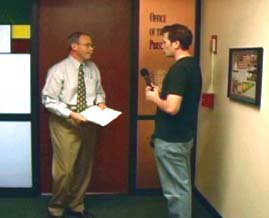
Well, it's time for podcast #2 of the Dr. Helen/Instapundit show. In honor of the American Renaissance Film festival this weekend in Los Angeles, we will be talking with Stuart Browning and Evan Coyne Maloney of On The Fence films about their upcoming documentary, Indoctrinate U. It is a documentary about political correctness on college campuses and after seeing some of the footage, I have to say, it is a terrific body of work. For anyone out there who has had to bite their tongue in the classroom, been raked over the coals by a PC professor or lost their job due to unpopular political views, this podcast is for you. Click here to play the podcast. You can also subscribe via iTunes.
And if you have suggestions, leave them in the comments!
Somehow Being Sweet Like a Sailor does not have the Same Ring
Since when is cursing like a sailor against the law? I do it all the time so I was surprised when one of my readers (thanks Bruce) emailed me this Chicago Tribune article about a sailor who is facing a court martial and criminal charges brought against him for doing what sailors do best--cursing. He is also being charged with sexual harrassment for making some "spicy comments" about his ex-wife that was overheard by a female midshipman. I'm sorry but if you can't take men or women talking this way even to your face, you do not belong in the Navy but in a convent where sweet, untarnished behavior is expected. The good news is, the article reports that sexual harrassment complaints are down, but this is not enough for champions of victims rights:
Wow, I trust Wellesley College to make unbiased decisions on the behalf of women--I mean victims--everywhere. Somehow, I bet that if we did not have enough victims already, we'll certainly be having more if such an asinine bill flies.
This is not necessarily good news if you're in the business of victim advocacy--and it is a business, perhaps soon to become a career choice if Rep. Louise Slaughter (D-N.Y.) has her way. Slaughter is the sponsor of a 95-page bill that would create a Pentagon Office of Victim Advocacy. We may never win the war on terror, but we'll by golly win the war on hurt feelings.
Slaughter's bill has met with little success thus far, but the Pentagon is working on the idea. Elaine Donnelly, president of the Center for Military Readiness, reports that the Pentagon contracted with the Wellesley College Centers for Women to study the idea of an OVA and make recommendations. Wellesley has submitted a report for which it was paid $50,000, but the Pentagon has not released it.
Wow, I trust Wellesley College to make unbiased decisions on the behalf of women--I mean victims--everywhere. Somehow, I bet that if we did not have enough victims already, we'll certainly be having more if such an asinine bill flies.
Tuesday, January 10, 2006
Some Secrets are Better Left Unsaid
Have you ever been to the website Postsecrets.com? It's an interesting site where people send in their secrets on a postcard to Frank, a guy in Maryland who puts them on his site. He also has a book, PostSecret : Extraordinary Confessions from Ordinary Lives, which I bought for someone as a gift. I know this site is popular, but if I had a secret to write in to him, it would be that I really hate some of the secrets he shares! Some of the secrets are so downright pathetic and cruel that frankly, I wonder about the morals of some of the authors of these little gems. For example, one postcard read, "It makes me very happy when I hear about a hunter accidentally getting killed while hunting, wish it would happen more often." Charming. Another postcard reads, "I gave a child up for adoption 25 years ago. She found me. I wish to God I had had the abortion instead." Of course, some of the secrets people send in are sweet and sincere or just disturbing but not morally bankrupt. Check it out if you have not been to the site. It is rather interesting.
which I bought for someone as a gift. I know this site is popular, but if I had a secret to write in to him, it would be that I really hate some of the secrets he shares! Some of the secrets are so downright pathetic and cruel that frankly, I wonder about the morals of some of the authors of these little gems. For example, one postcard read, "It makes me very happy when I hear about a hunter accidentally getting killed while hunting, wish it would happen more often." Charming. Another postcard reads, "I gave a child up for adoption 25 years ago. She found me. I wish to God I had had the abortion instead." Of course, some of the secrets people send in are sweet and sincere or just disturbing but not morally bankrupt. Check it out if you have not been to the site. It is rather interesting.
Fear
Do you have a phobia of something so strong that just the thought of it sets you into a tailspin? I know I do. My fear is public speaking--I hate it. I have done everything I can to face my fears, including reading books like Feel the Fear and Do It Anyway, but sometimes, I have to remind myself that pushing through fear no matter what is not always the answer.
The fear of public speaking started in high school; before that, I could get up in front of the class with some trepidation but I was able to do it. But that all changed in 10th grade English class. I had to give a report on The Canterbury Tales and when I got up to speak, I just lost it. I had already been ignored and/or verbally abused by half the kids in the class and facing them brought the fear I had been hiding for years to the forefront. I froze. Have you ever froze in front of a group of 10th graders? They burst into laughter--the teacher tried to put things into perspective by saying, "We're laughing with you, not at you." Yeah, right. I never spoke again in class until my last year in college when I was stuck giving a speech in a required class I needed to graduate. I stumbled through it the best I could--all the while feeling my heart pound and the room spin. I somehow made it through and even got an A with a comment from the professor, "try to look people in the eye when you speak."
My next bout with public speaking came in graduate school; I was really lucky as The New School for Social Research in NYC had a European style of teaching which meant very large classes where I could slink in the back of the room and then take one written test for my whole semester grade. It was impersonal and suited me fine--I did not have to interact or talk to anyone until my last semester in a small seminar. Again, I needed the class to graduate and had to force myself to attend. The class was taught by my worst nightmare--a strong-willed Israeli professor who seemed to get a sadistic thrill out of poking fun at the "dumb American students." This mean streak got even worse when she announced that in order to pass the course--each one of us would take our turn "teaching" the class on a different topic. You can only imagine the torment I went through trying to teach on language development in children in front of a malevolent professor who took pleasure in pointing out my every flaw. I rejoiced to get a B- in this woman's class and never have to deal with her again.
So, fast forward to today. Despite the weeks of anxiety beforehand, shortness of breath, and my heart beating out of my chest, I have perservered in the public speaking arena--and it has never gotten better. I have forced myself to give testimony to legislatures, talked to crowds of 500 about my film, and spoken to groups of professionals about kids who are violent. You would think that after all this--I would feel less fear. But I never do. It is there each time, as strong as ever. A colleague said to me once, "it is not necessary to speak because you think you have to, but it is necessary to be able to speak if you want to." I think this is the crucial difference. If we face our fears because they keep us from doing something that we want to do, that is one thing--but I have learned that I no longer have to face my fears just to prove to myself that I am not afraid.
Do you have any fears you could share--and if so, how did you overcome them, or not?
but sometimes, I have to remind myself that pushing through fear no matter what is not always the answer. The fear of public speaking started in high school; before that, I could get up in front of the class with some trepidation but I was able to do it. But that all changed in 10th grade English class. I had to give a report on The Canterbury Tales and when I got up to speak, I just lost it. I had already been ignored and/or verbally abused by half the kids in the class and facing them brought the fear I had been hiding for years to the forefront. I froze. Have you ever froze in front of a group of 10th graders? They burst into laughter--the teacher tried to put things into perspective by saying, "We're laughing with you, not at you." Yeah, right. I never spoke again in class until my last year in college when I was stuck giving a speech in a required class I needed to graduate. I stumbled through it the best I could--all the while feeling my heart pound and the room spin. I somehow made it through and even got an A with a comment from the professor, "try to look people in the eye when you speak."
My next bout with public speaking came in graduate school; I was really lucky as The New School for Social Research in NYC had a European style of teaching which meant very large classes where I could slink in the back of the room and then take one written test for my whole semester grade. It was impersonal and suited me fine--I did not have to interact or talk to anyone until my last semester in a small seminar. Again, I needed the class to graduate and had to force myself to attend. The class was taught by my worst nightmare--a strong-willed Israeli professor who seemed to get a sadistic thrill out of poking fun at the "dumb American students." This mean streak got even worse when she announced that in order to pass the course--each one of us would take our turn "teaching" the class on a different topic. You can only imagine the torment I went through trying to teach on language development in children in front of a malevolent professor who took pleasure in pointing out my every flaw. I rejoiced to get a B- in this woman's class and never have to deal with her again.
So, fast forward to today. Despite the weeks of anxiety beforehand, shortness of breath, and my heart beating out of my chest, I have perservered in the public speaking arena--and it has never gotten better. I have forced myself to give testimony to legislatures, talked to crowds of 500 about my film, and spoken to groups of professionals about kids who are violent. You would think that after all this--I would feel less fear. But I never do. It is there each time, as strong as ever. A colleague said to me once, "it is not necessary to speak because you think you have to, but it is necessary to be able to speak if you want to." I think this is the crucial difference. If we face our fears because they keep us from doing something that we want to do, that is one thing--but I have learned that I no longer have to face my fears just to prove to myself that I am not afraid.
Do you have any fears you could share--and if so, how did you overcome them, or not?
Medical Weblog Awards
My blog has been nominated for best Health policies/ethics blog at Medgadget.com. I don't really think of myself as a medical blog--mainly I just write about topics that are of interest to me. But if you are so inclined--go vote, either for me or check out the other terrific medical blogs. Voting goes on until January 15th.
Medical Ground Rounds is Up
The Clinical Cases and Images blog is hosting grand rounds of the best posts of the medical blogosphere. The topics are varied--ranging from a discussion of Ariel Sharon's cerebral hemmorage to a suicide bomber with hepatitis who blew himself up and his body particles infected a survivor of the blast. Check it out.
Monday, January 9, 2006
What the Hell Happened to Freedom of Speech?
Can this really be true? thanks to SayUncle--another local Tennessee blogger.
Update: Here are some more thoughts and information on this annoying clause.
Update: Here are some more thoughts and information on this annoying clause.
Podcasting for Dummies
Thanks to those of you who have listened and commented on our first podcast--some people have asked for more information on the equipment we used and for information on podcasting in general which you can read here at Glenn's site. I like the idea of podcasting as you can do it at your convenience, pick your own guests and ideas--even unpopular ones, and don't have to get out of your pajamas to do an interview. I wish I had a job like that.
Sunday, January 8, 2006
The Dr. Helen / InstaPundit Podcast

Our first show is with Michelle Malkin author of Unhinged: Exposing Liberals Gone Wild, and blogger at MichelleMalkin.com. She talks about being an author, a mom, and the target of thousands of extremely nasty emails.
Our other interview is with Internet rock star Audra Coldiron of Audra and the Antidote. She talks about being an outcast in high school, and how she used that experience as inspiration in her songwriting -- and how she hopes her new baby won't grow up to have the same awful experiences.
You can listen to the podcast by clicking here. (You don't need an iPod to listen to podcasts!) If you want to subscribe to get future podcasts, just copy this link and paste it into your podcast-listening software. You'll also be able to subscribe through iTunes soon. Hope you like it! If you've got suggestions for future topics, or guests, let me know by comment or email.

Death T-shirts in the News
Here is a an article about Medtees.com in the Chicago Tribune today with some quotes from me touting the humor of these t-shirts. But the message of these shirts for people who are ill is a serious one:
I remember after my heart attack that doctors told me that no one would know that I had an "imperfect body" but a cardiologist, but I know it everyday--and sure as hell don't try to hide it. People get sick and they get old--so what? It is part of the human condition--but rising above it to do the best we can with the life we have is the answer, not trying to pretend that we are immortal.
The MedTees T-shirts are the brainchild of Evanston Northwestern physician Wes Fisher and his wife, Diane. Fed up with a culture that they say resists the natural processes of aging and illness like leprosy, the Fishers' idea allows patients and people with illnesses to poke fun at their ailments.
"It's kind of a countercultural idea," Wes Fisher said in the kitchen of his home. "People in Western culture really don't think it's OK to have an illness or be sick. We have a media image of the perfect body."
I remember after my heart attack that doctors told me that no one would know that I had an "imperfect body" but a cardiologist, but I know it everyday--and sure as hell don't try to hide it. People get sick and they get old--so what? It is part of the human condition--but rising above it to do the best we can with the life we have is the answer, not trying to pretend that we are immortal.
Saturday, January 7, 2006
The Holocaust--Just another Postmodern Invention?
Is the Holocaust just another postmodern figment of the West's imagination? Apparently, this is what some prominent Muslim leaders think:
Have you noticed that as time goes on and people start to forget the horror of tragedy that the mind tends to rewrite the past? Perhaps this is human--for example, a family member dies and we rewrite their life to fit into our own scheme of how we feel about our own lives. If Dad was a fairly pleasant guy, we might overstate how cruel he was to keep ourselves from grieving. But on the other hand, if Dad was downright cruel and abusive, we might rewrite history in our minds to make him out to be a good guy. Either way of thinking puts our mind at ease and gives us the opportunity to feel virtuous about ourselves. In the case of these Muslim leaders with dementia times two, we have a case where they use the denial of the Holocaust as a tool for provoking sympathy from the West and anger in their followers in the Mideast. What better way to further their cause. But can we really allow them to use the bodies of six million corpses to make a political point?
Update: Ed Driscoll has more thoughts--be sure and read the information on political science Professor Sindi who has taught in the past at UC Irvine and Cal State Pomona--and who believes in the Holocaust Denial and is teaching American students.
Up until now, it was unnecessary in the West, outside of Germany and Austria, to pay serious attention to those who disputed the historicity of the Holocaust: they constituted a tiny fringe group, and dismissing their views had little political risks or consequences. They could simply be shrugged off as quacks, at best, and crypto-Nazis, at worst. But this recent wave of Holocaust denial is not coming from a statistically insignificant potion of the West; it is coming from Muslim leaders with popular followings, and what is even more troublesome, it is not being challenged by others in the Muslim community. As the head of the Simon Wiesenthal Center said, "The problem is that so far in the Arab world, very few leaders are willing to tell their own people that they have to understand that the Holocaust did take place” -- a statement that is putting it very mildly, indeed.
Are we dealing here with simply two different but equally legitimate points of view of what happened to the Jews under Nazi Germany; or are we dealing with a new ideological virus, and one that is on the verge of spreading like an epidemic?
We in the West have already rewritten a great deal of history in the name of cultural tolerance and diversity. But are we prepared to deny the truth of the Holocaust in the name of the same principles?
Have you noticed that as time goes on and people start to forget the horror of tragedy that the mind tends to rewrite the past? Perhaps this is human--for example, a family member dies and we rewrite their life to fit into our own scheme of how we feel about our own lives. If Dad was a fairly pleasant guy, we might overstate how cruel he was to keep ourselves from grieving. But on the other hand, if Dad was downright cruel and abusive, we might rewrite history in our minds to make him out to be a good guy. Either way of thinking puts our mind at ease and gives us the opportunity to feel virtuous about ourselves. In the case of these Muslim leaders with dementia times two, we have a case where they use the denial of the Holocaust as a tool for provoking sympathy from the West and anger in their followers in the Mideast. What better way to further their cause. But can we really allow them to use the bodies of six million corpses to make a political point?
Update: Ed Driscoll has more thoughts--be sure and read the information on political science Professor Sindi who has taught in the past at UC Irvine and Cal State Pomona--and who believes in the Holocaust Denial and is teaching American students.
Friday, January 6, 2006
Mentors
Did you ever have a mentor--either a personal or professional one who guided you through the intricacies of life and work? I had a terrific mentor when I was in my early twenties who not only helped me learn to do my job well but taught me how to live my life well. His name was Dr. Fred Wisner and his office was on Central Park West next to the Dakota building where John Lennon was shot. Every week when I would go to see Dr.Wisner for our weekly supervision sessions, I would pass by the area where Lennon was killed and think about the reasons that a madman like Mark Chapman would kill Lennon in the first place.
It was Dr. Wisner who helped me understand the human mind and to delve into my patient's psyche without being afraid of the darkness that was there. He took me inside the minds of Nazi War criminals like Rudolph Hess through his interpretations of the Rorschach cards and taught me that Nazis had no special skills or insight. They were simply average in intelligence and had no empathy for their fellow man. He taught me that degrees meant little except as an entry into a profession and that one's life work in psychology had more to do with being human and connecting with others than it did with being intellectual and right.
He told me stories about himself being a psychologist in training and wondering if he would be good at this work. He watched his own supervisor, a psychiatrist, pick up a depressed crying male patient and hold him gently on his lap and rock him back and forth until he was soothed. This gentleness helped him to understand how fragile the human psyche can be and yet how strong one must be in his masculinity to soothe a child like this. Dr. Wisner realized that this work was important and that he could help his patients. Today, perhaps his mentor would be afraid to hold a child for fear of a lawsuit--too bad, because the boy and I would have missed out on the usefulness of this story.
Dr. Wisner also taught me that being a therapist was like being an actor because actors took on the personality and personna of those they portray--I learned to get inside my patient's skins in a way that helped me sort out their pain and suffering as well as my own. After exploring the recesses of my own mind, I learned that there was nothing to fear in the torment of others. Dr. Wisner taught me to have self-confidence in my skills and in myself. He taught me that I was brave even when I felt low and down--he would point out all the positive things I had done with my life where I saw only darkness.
When I would leave his office, I felt light and buoyant--like I had chosen the best line of work that life had to offer. But what I did not realize at the time was that it was not just the job decisions that he had helped me with, it was understanding how to deal with my inner life and the world around me. I cannot think of a better gift I could have been given.
So, wherever you are Dr. Wisner, all I can say is thank you.
Thursday, January 5, 2006
Positive Psychology
Many of my readers have commented on the focus of unhappiness or psychopathology in psychology. Martin Seligman is a professor of psychology at the University of Pennsylvania who founded Positive Psychology. Positive Psychology focuses on one's strengths rather than weaknesses, and asserts that happiness is not the result of genes or good luck. In his book, Authentic Happiness : Using the New Positive Psychology to Realize Your Potential for Lasting Fulfillment, Seligman teaches readers that happiness can be cultivated by identifying and using many of the strengths they already possess. If you would like to see what your signature strengths are, you can take the Signature Strength Survey at authentichappiness.org. There is even a test designed to test the signature strengths in children coming soon.
Take the test when you have a few minutes although they have a shortened version. Just for the record, my top signature strengths are bravery and valor defined as "you do not shrink from threat, challenge, pain or difficulty. Valor is more than bravery under fire, when one's physical well-being is threatened. It refers as well to intellectual or emotional stances that are unpopular, difficult, or dangerous." (This sounds like many of the bloggers I read).
Okay, that looks pretty accurate for me. I have always prized people who are brave and I despise cowardliness in people--and especially in myself. Anyway, take a look at the website if you would like to learn what strengths you have and if you feel like sharing--post a comment about it--or about your thoughts on positive psychology in general.
Seligman teaches readers that happiness can be cultivated by identifying and using many of the strengths they already possess. If you would like to see what your signature strengths are, you can take the Signature Strength Survey at authentichappiness.org. There is even a test designed to test the signature strengths in children coming soon.Take the test when you have a few minutes although they have a shortened version. Just for the record, my top signature strengths are bravery and valor defined as "you do not shrink from threat, challenge, pain or difficulty. Valor is more than bravery under fire, when one's physical well-being is threatened. It refers as well to intellectual or emotional stances that are unpopular, difficult, or dangerous." (This sounds like many of the bloggers I read).
Okay, that looks pretty accurate for me. I have always prized people who are brave and I despise cowardliness in people--and especially in myself. Anyway, take a look at the website if you would like to learn what strengths you have and if you feel like sharing--post a comment about it--or about your thoughts on positive psychology in general.
Even the "Poor" have a Computer
If you have ever thought that the "poor" in this country still live a fairly comfortable lifestyle, here is an interesting article confirming this:
I wonder about the Census report for the lower middle class--would this many respondents say they had no unmet needs for a doctor and no unpaid rent?
The Census report also compares, from 1992 through 1998, people's perceptions of whether basic needs were being met. More than 92% of Americans below the poverty line said they had enough food, as of 1998. Some 86% said they had no unmet need for a doctor, 89% had no roof leaks, and 87% said they had no unpaid rent or mortgage.
I wonder about the Census report for the lower middle class--would this many respondents say they had no unmet needs for a doctor and no unpaid rent?
Wednesday, January 4, 2006
Tuesday, January 3, 2006
The Inverse Authoritarian Personality
I recently wrote a post stating that I ordered the book, Roots of Radicalism: Jews, Christians, and the Left. Well, it finally came and I have spent some interesting hours reading about studies done with Jewish and Christian leftist radicals in the 1970's and 80's. Please bear the age of these studies in mind when I talk about some of the information I gleaned from the book. Yes, this is old stuff but I think in discussing some of the traits of radicals on the left, much of it still holds true. I do not believe these traits are necessarily pathological--but they are descriptive in helping to understand those who follow extreme left-leaning thought.
The book discusses the classic authoritarian who adopts conservative ideas to defend himself against his underlying conflicts and insecurity--of course the authoritarian personality was first formulated by scholars who were quintessential outsiders: "leftist, internationalist, deracinated Jewish academics who were refugees from resurgent German nationalism, political reaction and virulent anti-Semitism." To read more about the authoritarian personality, read Theodor Adorno's work on the topic--it is beyond the scope of this post.
The authors of the book, Stanley Rothman & S. Robert Lichter spend chapters discussing how the same conflicts that underlie the authoritarian can be turned inside out. "The traditional authoritarian deflects his hidden hostilities onto outsiders and outgroups. The inverse (my italics) authoritarian unleashes his anger directly against the powers that be while taking the side of the world's 'victims' and 'outcasts.'" The authors ask an important question about the inverse authoritarian: "Was it not possible that the 'liberated generation' was bound to potentially dangerous unconscious personality dynamics no less than its forebears?"
The authors set about to study the new left in the 1970's with a variety of psychological tests and clinical interviews. I am certainly simplifying their work for the sake of space, but they found through testing that the inverse authoritarian rejects social authority out of hand and aligns himself with militant opponents of the established order. "These identifications give moral legitimacy to his desire to act out aggressive impulses by preaching or practicing 'revolutionary' confrontation and violence. Thus he identifies potency with force and militancy, projecting fantasized power and vitality onto society's outcasts and outsiders. At the same time, he scorns his own bourgeois intellectual background as impotent, a projection of the weakness he fears in himself."
Without going into too much detail, here are a few other things they found. Conservatives--particularly Jewish Conservatives--were found to be lowest on the need to feel powerful, followed by liberals but the need to feel powerful rose sharply among the New Left radical group--it was especially high in the Jewish radicals. Jewish conservatives, liberals, and radicals were all more affiliative (defined as a concern to establish, maintain and restore positive emotional relationships) than their non-Jewish counterparts.
What I carried away from the book is that there is no difference in the rigidity between fighting against outsiders or outgroups and fighting against the establishment---both are a form of rebellion that is based not on what is right, but on how one chooses to rebel. Basing politics and policy on how they fullfill our need for power, affiliation or hostility cannot be the best way of deciding what is right for our country.
Update: And, sometimes, being angry and stupid is not enough.
Well, it finally came and I have spent some interesting hours reading about studies done with Jewish and Christian leftist radicals in the 1970's and 80's. Please bear the age of these studies in mind when I talk about some of the information I gleaned from the book. Yes, this is old stuff but I think in discussing some of the traits of radicals on the left, much of it still holds true. I do not believe these traits are necessarily pathological--but they are descriptive in helping to understand those who follow extreme left-leaning thought. The book discusses the classic authoritarian who adopts conservative ideas to defend himself against his underlying conflicts and insecurity--of course the authoritarian personality was first formulated by scholars who were quintessential outsiders: "leftist, internationalist, deracinated Jewish academics who were refugees from resurgent German nationalism, political reaction and virulent anti-Semitism." To read more about the authoritarian personality, read Theodor Adorno's work on the topic--it is beyond the scope of this post.
The authors of the book, Stanley Rothman & S. Robert Lichter spend chapters discussing how the same conflicts that underlie the authoritarian can be turned inside out. "The traditional authoritarian deflects his hidden hostilities onto outsiders and outgroups. The inverse (my italics) authoritarian unleashes his anger directly against the powers that be while taking the side of the world's 'victims' and 'outcasts.'" The authors ask an important question about the inverse authoritarian: "Was it not possible that the 'liberated generation' was bound to potentially dangerous unconscious personality dynamics no less than its forebears?"
The authors set about to study the new left in the 1970's with a variety of psychological tests and clinical interviews. I am certainly simplifying their work for the sake of space, but they found through testing that the inverse authoritarian rejects social authority out of hand and aligns himself with militant opponents of the established order. "These identifications give moral legitimacy to his desire to act out aggressive impulses by preaching or practicing 'revolutionary' confrontation and violence. Thus he identifies potency with force and militancy, projecting fantasized power and vitality onto society's outcasts and outsiders. At the same time, he scorns his own bourgeois intellectual background as impotent, a projection of the weakness he fears in himself."
Without going into too much detail, here are a few other things they found. Conservatives--particularly Jewish Conservatives--were found to be lowest on the need to feel powerful, followed by liberals but the need to feel powerful rose sharply among the New Left radical group--it was especially high in the Jewish radicals. Jewish conservatives, liberals, and radicals were all more affiliative (defined as a concern to establish, maintain and restore positive emotional relationships) than their non-Jewish counterparts.
What I carried away from the book is that there is no difference in the rigidity between fighting against outsiders or outgroups and fighting against the establishment---both are a form of rebellion that is based not on what is right, but on how one chooses to rebel. Basing politics and policy on how they fullfill our need for power, affiliation or hostility cannot be the best way of deciding what is right for our country.
Update: And, sometimes, being angry and stupid is not enough.
Carnival of Homeschooling
Check out the Carnival for Homeschooling. Check out the advice on homeschooling for fathers--there are some good tips.
Monday, January 2, 2006
Canadian Female Criminals are Just Big Kids
If you are are female and want to get away with murder, just head to Canada. Kala Homolka was freed from prison recently after just twelve years for the killing of three women--one of them her fifteen year old sister,Tammy Lynn. Karla even took part in raping her sister. Naturally, she blamed her husband, Paul Bernardo, for the whole thing and was given a lighter sentence for agreeing to testify against him. Despite video tapes showing Karla to have participated in these crimes, she was seen as a victim, especially because she was fair-haired and beautiful, kind of like an innocent child. If you want to read more about Karla Homolka's case and the politics and psychology of female killers, I highly recommend When She Was Bad: How and Why Women Get Away With Murder.
Apparently, in Canada, if you just say you are sorry, you may not serve any jail time at all, and if you are female, all bets are off for what type of reduced sentence you can finagle out of the court system:
And if you cannot stick to lower level types of crime, you can murder without having to lose too much time at work:
Wow, a slap on the wrist, being sent to your room and having to talk to a counselor. In Canada, women can revel in being treated like children. My only question is, with this patriarchal system of justice in Canada, should women really be allowed to vote? Or is this just Canada's tradition of niceness being carried to ridiculous extremes?
Update: Thanks to Lex's blog for pointing out these crime stats which show that Canada has more attempted crime and crime per 100,000 people than the US. Perhaps the US may not be such a den of iniquity afterall.
Apparently, in Canada, if you just say you are sorry, you may not serve any jail time at all, and if you are female, all bets are off for what type of reduced sentence you can finagle out of the court system:
Female criminals have it even easier. Just over 15 per cent of women convicted of a crime will ever see the inside of a cell. The average stay, for those unlucky few who have to serve time, is just over 90 days for single crime, just under six months for multiple crimes. The average length of probation was about 15 months for "single-conviction" cases, about 19 months for multiple-conviction criminals.
And if you cannot stick to lower level types of crime, you can murder without having to lose too much time at work:
Consider the sentence of Teresa Layne Senner, of Vanderhoof, B.C. She killed Norman Wicks in November 2002 with a single knife stab to the groin after Wicks informed her he would not leave his wife to marry her, and after she learned he was having affairs with at least three other women besides her.
When Senner confronted Wicks in his home, she testified "stuff just started flying," including the knife that just happened to end up in her hand and then in his crotch.
The judge claimed not to buy her excuse that she was merely trying to get the knife out of the way of their quarrel, and safeguard Wicks, when the blade accidentally ended up in his nether regions.
The trial judge admitted most of Senner's testimony did not stand up to close examination. Nonetheless, because she "had no criminal record and had been a contributing member of society," he handed her a conditional sentence of two years less a day. She may live in her home and continue working. The only conditions are that she seek counselling and obey an 8 p.m. to 6 a.m. curfew.
Wow, a slap on the wrist, being sent to your room and having to talk to a counselor. In Canada, women can revel in being treated like children. My only question is, with this patriarchal system of justice in Canada, should women really be allowed to vote? Or is this just Canada's tradition of niceness being carried to ridiculous extremes?
Update: Thanks to Lex's blog for pointing out these crime stats which show that Canada has more attempted crime and crime per 100,000 people than the US. Perhaps the US may not be such a den of iniquity afterall.
Sunday, January 1, 2006
Carnival of the Insanities
The Carnival of the Insanities is up over at Dr. Sanity's blog. My favorite is #7 which is a post on bizzare politically correct college courses.
Happy New Year!
I have said before that I do not make New Year's resolutions but I have decided there are a few things I am willing to try for 2006. I may not succeed but the following can serve as a general guide to improving my life (or others') in the coming year:
1) Try to be less grumpy--I tend to have the disposition of a grumpy old man--at least that is what people tell me. I feel happy this way but if it is raining on other people's parade, maybe I can try to put on a fake smile or laugh once in a while. Of course, then people get mad because I look like I am faking being happy. Maybe my resolution should be that I cannot please everyone.
2) Quit reading the Star and National Enquirer for all my entertainment needs--Hollywood Stars really do not deserve our hard earned money to keep themselves in the limelight. There is satellite radio, alternative artists and documentaries to keep me entertained at a higher level of intellectual engagement than the tabloids, although I love them dearly. To tell you the truth, I find the tabloids sometimes report news more accurately than the MSM or provide information that I normally would not see much of in the MSM. Case in point. I was reading The National Enquirer this week and found that Karla Homolka, a three time killer, is being released from prison in Quebec with no restrictions after serving only 12 years (she helped cops put away her husband for life, although he reports that one of the killings was done by Karla alone). I would not have seen this if it was not for The National Enquirer. Where are all the celebrities in an outrage over Karla getting out without supervision to roam the streets? Oh, well, another good reason to quit supporting tabloids that give press to celebrities and their pitiful causes.
3) Quit reading women's magazines. Okay, they are just plain depressing and downright dumb. I was treated to a copy of More magazine while getting my hair cut the other day and here are just a few tidbits I read before figuring out that staring at the salon ceiling and humming to myself presented a more tranquil and relaxing afternoon than thumbing through this trash. One of the articles contained the First Annual Media awards for women over 40 in the media. I know you will be shocked to hear that Cindy Sheehan made the list as "the woman we want on our team" and Maureen Dowd was chosen as "the needle of hope in the haystack of despair" award for her book, Are Men Necessary? If Maureen Dowd is your idea of hope for women in the media, I say, how low have we sunk?
Another enlightening article was on Mary Mapes starting over after she, Dan Rather, and CBS became the unfair targets of partisian bloggers! The only saving grace in this heroine-turned-victim saga is that her estranged father called a conservative radio talk show to claim she had always been a liberal and worse yet, a "radical feminist." Sometimes, father does know best.
4) Finally, read more blogs in 2006! There are so many blogs out there that I really enjoy. Just a few of my favorites are Ann Althouse, Asymmetrical Information, and David Bernstein and Dave Kopel at the Volokh Conspiracy. The blog I admired most in 2005 is Tas's blog who, despite being a liberal blogger, had the guts to stand up to the authoritarian lefty bloggers and tell it like it is.
So that is my list, I hope I can live up to it!
Update: Finally, someone likes me just the way I am!
1) Try to be less grumpy--I tend to have the disposition of a grumpy old man--at least that is what people tell me. I feel happy this way but if it is raining on other people's parade, maybe I can try to put on a fake smile or laugh once in a while. Of course, then people get mad because I look like I am faking being happy. Maybe my resolution should be that I cannot please everyone.
2) Quit reading the Star and National Enquirer for all my entertainment needs--Hollywood Stars really do not deserve our hard earned money to keep themselves in the limelight. There is satellite radio, alternative artists and documentaries to keep me entertained at a higher level of intellectual engagement than the tabloids, although I love them dearly. To tell you the truth, I find the tabloids sometimes report news more accurately than the MSM or provide information that I normally would not see much of in the MSM. Case in point. I was reading The National Enquirer this week and found that Karla Homolka, a three time killer, is being released from prison in Quebec with no restrictions after serving only 12 years (she helped cops put away her husband for life, although he reports that one of the killings was done by Karla alone). I would not have seen this if it was not for The National Enquirer. Where are all the celebrities in an outrage over Karla getting out without supervision to roam the streets? Oh, well, another good reason to quit supporting tabloids that give press to celebrities and their pitiful causes.
3) Quit reading women's magazines. Okay, they are just plain depressing and downright dumb. I was treated to a copy of More magazine while getting my hair cut the other day and here are just a few tidbits I read before figuring out that staring at the salon ceiling and humming to myself presented a more tranquil and relaxing afternoon than thumbing through this trash. One of the articles contained the First Annual Media awards for women over 40 in the media. I know you will be shocked to hear that Cindy Sheehan made the list as "the woman we want on our team" and Maureen Dowd was chosen as "the needle of hope in the haystack of despair" award for her book, Are Men Necessary? If Maureen Dowd is your idea of hope for women in the media, I say, how low have we sunk?
Another enlightening article was on Mary Mapes starting over after she, Dan Rather, and CBS became the unfair targets of partisian bloggers! The only saving grace in this heroine-turned-victim saga is that her estranged father called a conservative radio talk show to claim she had always been a liberal and worse yet, a "radical feminist." Sometimes, father does know best.
4) Finally, read more blogs in 2006! There are so many blogs out there that I really enjoy. Just a few of my favorites are Ann Althouse, Asymmetrical Information, and David Bernstein and Dave Kopel at the Volokh Conspiracy. The blog I admired most in 2005 is Tas's blog who, despite being a liberal blogger, had the guts to stand up to the authoritarian lefty bloggers and tell it like it is.
So that is my list, I hope I can live up to it!
Update: Finally, someone likes me just the way I am!
Subscribe to:
Comments (Atom)