No one feels very good about having a serious disease--be it heart disease, cancer, or a multiple of other scary diagnoses. However, there is a lighter side to having medical problems that I have just discovered anew this week. I am not sure what is going on at my local mall, but apparently, the metal detectors that screen for shoplifters have been reset to be more sensitive. Since getting my cardioverter implantable defibrillator last year, I can count on one hand how many metal detectors I have set off because of the metal in my device.
However, while shopping at the mall this week, I set off every detector I went near or by. At first, I was annoyed and with my pissed-off look, no clerks dared to stop me or ask me about the detector going off. I know that these things are set off frequently by other items but the rate they were going off the day I was shopping got to be comical. At one point, two teenage girls were behind me as the metal detector went off. I turned to see the store manager stopping the girls to ask them about the contents of their large purses. Me, I just saundered over to a bench, sat back and watched the show. Dark humor, yeah, I know, but give me a break--sometimes, being a medical freakshow has its sick twisted side.
My defibrillator has also gotten me some funny stories this week. I went in to see my electrophysiologist to check out my device. He and his staff looked rather disgusted and put out. As a psychologist, I couldn't help but ask them what the problem was. The physician's assistant just shook his head and said, "well, the patients we have here just don't listen. We just got a late call for an emergency from one of our patients this week who is about 70 years old. He has a defibrillator and heart problems and he is out drinking and partying with two hookers and his brother. He gets dehydrated from all of the alcohol, then has sex with the hookers and gets his heart rate over the recommended limit, then gets in a fight with his brother, his defibrillator goes off, shocks both of them, they fall down and end up in the emergency room. Then it's our problem." Somehow, the image of this guy and his brother being shocked in a drunken stupor seems more comical than anything. I realize it is serious but I have to admire the tenacity of these guys to party like this and live life with such gusto. Me--I'm sitting home drinking water and doing yoga. Who is having more fun?
Okay, maybe the hookers and high levels of booze are out for me--but the zest for life and lack of fear is frankly, more uplifting than scanning the internet about my condition and being convinced that each heartbeat is my last. After hearing another story about a patient of my doc's who has survived 66 shocks with his defibrillator, I would rather err towards throwing caution to the wind and enjoy life while I can then dwell on fear and doom. That, in the end, no matter how long each of us live, would be the biggest misfortune of all.
Update: Well, apparently Dick Cheney is not having as much fun as the guys I wrote about above (you know, the sex, hookers and all) as his defibrillator has not gone off yet. I guess running the country means means you have to take life a little more seriously.
Friday, June 30, 2006

Wednesday, June 28, 2006
The Carnival of Homeschooling
The 26th Carnival of Homeschooling is up at The Homeschool Cafe.
I thought this post about getting kids off sugar was interesting. I don't know if it improves behavior--maybe health--for those who don't process it well. Someone in the comments to the sugar post mentioned having problems if they eat Splenda--a sugar-free substitute. I notice that with any type of aspartame (nutrasweet), I get headaches and feel weird--although, I have read that this is common. I switched to Splenda but find I still feel rather sick if I eat too much of it. Anyone else have a sensitivity to sugar substitutes?
I thought this post about getting kids off sugar was interesting. I don't know if it improves behavior--maybe health--for those who don't process it well. Someone in the comments to the sugar post mentioned having problems if they eat Splenda--a sugar-free substitute. I notice that with any type of aspartame (nutrasweet), I get headaches and feel weird--although, I have read that this is common. I switched to Splenda but find I still feel rather sick if I eat too much of it. Anyone else have a sensitivity to sugar substitutes?
Tuesday, June 27, 2006
Podcast on the End of Medicine
Do you ever wonder if your doctor is really doing a thorough job when you go in for your yearly physical? I do. You go in and he/she hits your knee with a rubber hammer, runs a few blood tests and asks about any symptoms--all the time, checking their watch to make sure they can get to the next patient. What if a tumor is growing inside you or your arteries are clogging up faster than last night's dinner in the drain of your kitchen sink? Wouldn't you want to know in advance so that treatment could be started immediately before your life is threatened? Well, soon you might.
Today we are joined by Andy Kessler, the author of the new book, The End of Medicine : How Silicon Valley (and Naked Mice) Will Reboot Your Doctor. He talks to us about new technology (including his exerience with having a virtual colonoscopy), how Silicon Valley can assist in bringing healthcare prices down to scale, and how socialized medicine might be an impediment to living longer.
You can listen to the podcast by clicking here or via subscribing to iTunes. There's a lo-fi version for dialup here, and a complete podcast archive here. You can leave any suggestions or comments below.
Today we are joined by Andy Kessler, the author of the new book, The End of Medicine : How Silicon Valley (and Naked Mice) Will Reboot Your Doctor.
He talks to us about new technology (including his exerience with having a virtual colonoscopy), how Silicon Valley can assist in bringing healthcare prices down to scale, and how socialized medicine might be an impediment to living longer. You can listen to the podcast by clicking here or via subscribing to iTunes. There's a lo-fi version for dialup here, and a complete podcast archive here. You can leave any suggestions or comments below.
Saturday, June 24, 2006
Desperate for Friends?
There was an interesting article today in the Knoxville News Sentinel entitled Personal Bonds about a study at Duke University showing how "socially isolated" Americans are today as compared to 1985:
I wonder what this "friendless" society means in terms of people's behavior? For example, do disturbed people commit more mass murder in the US because they are so isolated and when pushed to the limit, feel they have nowhere to turn and no one to talk to? Is this study even correct--do people really stay away from others because they are so exhausted from work and long commutes, or is Desperate Housewives just more entertaining than exchanging verbal pleasantries with the neighbors? Finally, what is a friend and how do you define one? Frankly, I have people other than family I could count on to help out in certain situations and vice versa but I am not sure I would call them friends.
What do readers think--do you have any friends and if so, who do you consider a friend? If you don't have any friends, why not?
Update: Thanks to all the commenters so far who have written in to describe their desire or lack of desire for friends. As with most psychological characteristics, I think the need for friends spans a wide spectrum with some of us being outside the "norm" (whatever that means) in either direction. I will take the liberty of using some of the comments on friendship to clarify the spectrum of responses to closeness to other human beings.
Take for example, this commenter who describes friendship as so important that he puts in the effort even after moving:
"This entire thread is alien to me. I'm 60 years old and I have many friends. I'm still in contact with some of my friends from high school and college, even though I've lived in five different states since then and have never moved back "home". I've kept in contact with some people I've worked with, worked for and who worked for me. This took effort over the years."
Another commenter also prefers to "run like a pack":
I come from an "old world" culture where one's tight circle of friends - no more than half a dozen plus their significant others - was the be all and end all of one's world. One's family, essentially. Talk all the time, hang out all the time, go on trips together, essentially run like a pack; then co-raise one another's children and grow old together.
Yet at the other end, commenters describe being alone as a positive condition:
"Anon 5:40 says 'I'm a loner by nature and very happy that way.' Me too! I have a life-long friend, but I've not talked to him in 2-3 years and haven't seen him in close to 10. I haven't called him and he hasn't called me, but eventually when one of us does we'll pick up like we talked yesterday. Then go back into hibernation mode. I've always liked the line in the movie 'Heat' where the girl with a large family asks the DeNiro character with no family who lives alone, whether he's lonely. He replies, 'I live alone, but I'm not lonely.' Sums it up nicely, though a fictional bank robber as an example may not make a viable point!"
Some of us want friends but don't know how to get them:
"I try to think of myself as a 'lone wolf' but I am not. I am just the mangy pack member circling the group, trying to figure out where I might fit in, even only for a while."
'Friendships are a mystery to me. I'm 37, and still not sure how to 'make friends.'"
I think the lesson here is that friendship means different things to different people. Our threshold for human contact differs--some of us enjoy being alone, some are alone because they have no idea about how to make friends and others revel in numerous friendships and get joy from them. People affect people differently--if you are energized by people and feel pleasure in being with others (a typical extrovert), then friendships can be postive, but if you tend towards introversion, then people can sometimes exhaust you and make you feel blue instead of energized--perhaps more boundaries are needed to maintain your emotional health.
However, even an introvert may need other people--even one person who you can talk with and share some of yourself in ways that feel safe. I don't want to get into too many cliches such as 'if you want a friend, be a friend' but it is probably true. In addition, even if you do not have close friendships in your life, I think it is important to be willing to help others in times of need. I personally may not want to sit on my back porch chatting with a neighbor, but I would be happy to help them if they needed a hand (finding a lost dog, borrowing a tool, watching their house while they are on vacation etc.). If we could keep ourselves open to reaching out to others in times of need, yet still realize that we may need boundaries in our interactions with others, our lives would be greatly improved.
Americans are far more socially isolated today than they were two decades ago, and a sharply growing number of people say they have no one in whom they can confide, according to a comprehensive new evaluation of the decline of social ties in the United States.
A quarter of Americans say they have no one with whom they can discuss personal troubles, more than double the number who were similarly isolated in 1985. Overall, the number of people Americans have in their closest circle of confidants has dropped from around three to about two...
Compared with 1985, nearly 50 percent more people in 2004 reported that their spouse is the only person they can confide in. But if people face trouble in that relationship, or if a spouse falls sick, that means these people have no one to turn to for help, Smith-Lovin said.
The comprehensive new study paints a sobering picture of an increasingly fragmented America, where intimate social ties - once seen as an integral part of daily life and associated with a host of psychological and civic benefits - are shrinking or nonexistent. In bad times, far more people appear to suffer alone.
Smith-Lovin said increased professional responsibilities, including working two or more jobs to make ends meet, and long commutes leave many people too exhausted to seek social - as well as family - connections: "Maybe sitting around watching 'Desperate Housewives' ... is what counts for family interaction."
I wonder what this "friendless" society means in terms of people's behavior? For example, do disturbed people commit more mass murder in the US because they are so isolated and when pushed to the limit, feel they have nowhere to turn and no one to talk to? Is this study even correct--do people really stay away from others because they are so exhausted from work and long commutes, or is Desperate Housewives just more entertaining than exchanging verbal pleasantries with the neighbors? Finally, what is a friend and how do you define one? Frankly, I have people other than family I could count on to help out in certain situations and vice versa but I am not sure I would call them friends.
What do readers think--do you have any friends and if so, who do you consider a friend? If you don't have any friends, why not?
Update: Thanks to all the commenters so far who have written in to describe their desire or lack of desire for friends. As with most psychological characteristics, I think the need for friends spans a wide spectrum with some of us being outside the "norm" (whatever that means) in either direction. I will take the liberty of using some of the comments on friendship to clarify the spectrum of responses to closeness to other human beings.
Take for example, this commenter who describes friendship as so important that he puts in the effort even after moving:
"This entire thread is alien to me. I'm 60 years old and I have many friends. I'm still in contact with some of my friends from high school and college, even though I've lived in five different states since then and have never moved back "home". I've kept in contact with some people I've worked with, worked for and who worked for me. This took effort over the years."
Another commenter also prefers to "run like a pack":
I come from an "old world" culture where one's tight circle of friends - no more than half a dozen plus their significant others - was the be all and end all of one's world. One's family, essentially. Talk all the time, hang out all the time, go on trips together, essentially run like a pack; then co-raise one another's children and grow old together.
Yet at the other end, commenters describe being alone as a positive condition:
"Anon 5:40 says 'I'm a loner by nature and very happy that way.' Me too! I have a life-long friend, but I've not talked to him in 2-3 years and haven't seen him in close to 10. I haven't called him and he hasn't called me, but eventually when one of us does we'll pick up like we talked yesterday. Then go back into hibernation mode. I've always liked the line in the movie 'Heat' where the girl with a large family asks the DeNiro character with no family who lives alone, whether he's lonely. He replies, 'I live alone, but I'm not lonely.' Sums it up nicely, though a fictional bank robber as an example may not make a viable point!"
Some of us want friends but don't know how to get them:
"I try to think of myself as a 'lone wolf' but I am not. I am just the mangy pack member circling the group, trying to figure out where I might fit in, even only for a while."
'Friendships are a mystery to me. I'm 37, and still not sure how to 'make friends.'"
I think the lesson here is that friendship means different things to different people. Our threshold for human contact differs--some of us enjoy being alone, some are alone because they have no idea about how to make friends and others revel in numerous friendships and get joy from them. People affect people differently--if you are energized by people and feel pleasure in being with others (a typical extrovert), then friendships can be postive, but if you tend towards introversion, then people can sometimes exhaust you and make you feel blue instead of energized--perhaps more boundaries are needed to maintain your emotional health.
However, even an introvert may need other people--even one person who you can talk with and share some of yourself in ways that feel safe. I don't want to get into too many cliches such as 'if you want a friend, be a friend' but it is probably true. In addition, even if you do not have close friendships in your life, I think it is important to be willing to help others in times of need. I personally may not want to sit on my back porch chatting with a neighbor, but I would be happy to help them if they needed a hand (finding a lost dog, borrowing a tool, watching their house while they are on vacation etc.). If we could keep ourselves open to reaching out to others in times of need, yet still realize that we may need boundaries in our interactions with others, our lives would be greatly improved.
Wednesday, June 21, 2006
Tuesday, June 20, 2006
Why Dads Matter.
Update: The commenters in this post as well as previous ones seem to enjoy conversing with our prolific commenter on this blog, Greg Kuperberg. Greg now has his own blog where you can comment directly to him at The Quantum Group blog.
Update: The commenters in this post as well as previous ones seem to enjoy conversing with our prolific commenter on this blog, Greg Kuperberg. Greg now has his own blog where you can comment directly to him at The Quantum Group blog.
Sunday, June 18, 2006
Walking on Eggshells: Dealing with the Borderline in Your Life
Many times, patients or others ask me for a recommendation for a book or help for dealing with an angry, destructive person who is ruining their emotional health. My recomendation for a self-help book when coping with the aftermath of the borderline personality is Stop Walking on Eggshells: Taking Your Life Back When Someone You Care about Has Borderline Personality Disorder. But first of all, what is a borderline and how do know if that is what you are dealing with?
Certainly, one cannot diagnose someone without evaluating them, but many times, the descriptions people give me of their significant other, parent, child, or friend leads me to wonder if the advice seeker is dealing with a borderline. The DSM-IV describes the symptoms of Borderline Personality Disorder as:
1. frantic efforts to avoid real or imagined abandonment. (not including suicidal or self-mutilating behavior covered in Criterion 5)
2. a pattern of unstable and intense interpersonal relationships characterized by alternating between extremes of idealization and devaluation.
3. identity disturbance: markedly and persistently unstable self-image or sense of self.
4. impulsivity in at least two areas that are potentially self-damaging (e.g., spending, sex, substance abuse, reckless driving, binge eating; [not including] suicidal or self-mutilating behavior covered in Criterion 5).
5. recurrent suicidal behavior, gestures, or threats, or self-mutilating behavior
6. affective instability due to a marked reactivity of mood (e.g., intense episodic dysphoria, irritability, or anxiety usually lasting a few hours and only rarely more than a few days)
7. chronic feelings of emptiness.
8.inappropriate, intense anger or difficulty controlling anger (e.g., frequent displays of temper, constant anger, recurrent physical fights).
9. transient, stress-related paranoid ideation or severe dissociative symptoms.
There are even books on how to divorce a Borderline or Narcissistic Personality that give strategies to reduce the damage done to a person during the process. In a book entitled, "Splitting," one section looks at how a borderline can convince your own lawyer that they are right and turn the lawyer against you--I believe it and have seen it happen. I have worked in places where people believe that a borderline must be right because they are "intelligent." Intelligence and craziness are not separate traits--sometimes, someone who is intelligent can be even more emotionally damaging because they are smart enough to carry out manipulations that others can only dream about. So what do you do when encountering the borderline in your life?
Here are some tips from "Stop Walking on Eggshells" (page 140) with some of my own advice thrown in--for brevity's sake, I will list just a few, but if you want more detail-- get the book or go to BPD Central.
1) Stop "sponging" and start "mirroring"--that is, some of those involved with borderlines tend to soak up the borderline's pain and rage and think this is helpful, but in reality, it is like filling up a black hole of emptiness and nothing is good enough. You can try to placate the borderline and work hard to give them love, care etc. but it is never enough. Instead--reflect the painful feelings of the borderline back where they belong--with the borderline.
2) Stay focused and observe your limits. Show by your actions that you have the bottom line. Communicate the limits clearly and act on them consistently. Protect yourself and your children by removing them and yourself from the situation. For example, if a borderline flies into a rage and starts accusing you of things you did not do, tell him or her that you will be taking the kids out until they calm down and you can talk later.
3) Ask the borderline for change. Figure out your personal limits (get help from a therapist if needed) and communicate these to the borderline in a clear manner. However, ask for changes in behavior, not necessarily for changes in feelings--that is, you can ask them to change the behavior of yelling at you, but don't tell them not to be angry.
Finally, the best advice for those who are not yet involved legally with a borderline is a statement I heard from a colleague recently, "Borderlines make great girlfriends (or boyfriends) but you wouldn't want to marry one."
That, I think, sums it up in a nutshell--no offense, but the damage I have seen on victims of those who have borderline personality is not something to be taken lightly. People say that those with BPD can change but often times, they wreck havoc on their spouses, children and/or parents and the abuse lasts a lifetime. Children of those with BPD have trouble in future relationships by seeking out the love of the BPD that they could never get or by avoiding people in the future for fear of more emotional blackmail. Spouses of the BPD seem devastated and often end up with lives of quiet desperation or in the throes of accusations in court and parents end up believing that they are inadequate and incompetent. None of it sounds promising.
Have any readers been involved with a borderline personality disorder--either married to one, or have a parent, child or friend with this disorder-and if so, how did you cope?
Update: Some readers have emailed or asked for more information on a promising treatment for BPD called Dialectical Behavioral Therapy (DBT). Take a look at Behavioraltech.com for answers about DBT.
But first of all, what is a borderline and how do know if that is what you are dealing with? Certainly, one cannot diagnose someone without evaluating them, but many times, the descriptions people give me of their significant other, parent, child, or friend leads me to wonder if the advice seeker is dealing with a borderline. The DSM-IV describes the symptoms of Borderline Personality Disorder as:
1. frantic efforts to avoid real or imagined abandonment. (not including suicidal or self-mutilating behavior covered in Criterion 5)
2. a pattern of unstable and intense interpersonal relationships characterized by alternating between extremes of idealization and devaluation.
3. identity disturbance: markedly and persistently unstable self-image or sense of self.
4. impulsivity in at least two areas that are potentially self-damaging (e.g., spending, sex, substance abuse, reckless driving, binge eating; [not including] suicidal or self-mutilating behavior covered in Criterion 5).
5. recurrent suicidal behavior, gestures, or threats, or self-mutilating behavior
6. affective instability due to a marked reactivity of mood (e.g., intense episodic dysphoria, irritability, or anxiety usually lasting a few hours and only rarely more than a few days)
7. chronic feelings of emptiness.
8.inappropriate, intense anger or difficulty controlling anger (e.g., frequent displays of temper, constant anger, recurrent physical fights).
9. transient, stress-related paranoid ideation or severe dissociative symptoms.
There are even books on how to divorce a Borderline or Narcissistic Personality that give strategies to reduce the damage done to a person during the process. In a book entitled, "Splitting," one section looks at how a borderline can convince your own lawyer that they are right and turn the lawyer against you--I believe it and have seen it happen. I have worked in places where people believe that a borderline must be right because they are "intelligent." Intelligence and craziness are not separate traits--sometimes, someone who is intelligent can be even more emotionally damaging because they are smart enough to carry out manipulations that others can only dream about. So what do you do when encountering the borderline in your life?
Here are some tips from "Stop Walking on Eggshells" (page 140) with some of my own advice thrown in--for brevity's sake, I will list just a few, but if you want more detail-- get the book
or go to BPD Central.1) Stop "sponging" and start "mirroring"--that is, some of those involved with borderlines tend to soak up the borderline's pain and rage and think this is helpful, but in reality, it is like filling up a black hole of emptiness and nothing is good enough. You can try to placate the borderline and work hard to give them love, care etc. but it is never enough. Instead--reflect the painful feelings of the borderline back where they belong--with the borderline.
2) Stay focused and observe your limits. Show by your actions that you have the bottom line. Communicate the limits clearly and act on them consistently. Protect yourself and your children by removing them and yourself from the situation. For example, if a borderline flies into a rage and starts accusing you of things you did not do, tell him or her that you will be taking the kids out until they calm down and you can talk later.
3) Ask the borderline for change. Figure out your personal limits (get help from a therapist if needed) and communicate these to the borderline in a clear manner. However, ask for changes in behavior, not necessarily for changes in feelings--that is, you can ask them to change the behavior of yelling at you, but don't tell them not to be angry.
Finally, the best advice for those who are not yet involved legally with a borderline is a statement I heard from a colleague recently, "Borderlines make great girlfriends (or boyfriends) but you wouldn't want to marry one."
That, I think, sums it up in a nutshell--no offense, but the damage I have seen on victims of those who have borderline personality is not something to be taken lightly. People say that those with BPD can change but often times, they wreck havoc on their spouses, children and/or parents and the abuse lasts a lifetime. Children of those with BPD have trouble in future relationships by seeking out the love of the BPD that they could never get or by avoiding people in the future for fear of more emotional blackmail. Spouses of the BPD seem devastated and often end up with lives of quiet desperation or in the throes of accusations in court and parents end up believing that they are inadequate and incompetent. None of it sounds promising.
Have any readers been involved with a borderline personality disorder--either married to one, or have a parent, child or friend with this disorder-and if so, how did you cope?
Update: Some readers have emailed or asked for more information on a promising treatment for BPD called Dialectical Behavioral Therapy (DBT). Take a look at Behavioraltech.com for answers about DBT.
Friday, June 16, 2006
Ann Althouse has an interesting post about what schools would be like if they favored boys in the same way that schools now favor girls. Take a look.
Wednesday, June 14, 2006
Do These Women Exist?
A reader (thanks Roger) sent me a link to this article about a new book entitled, Why Men Marry Bitches : A Woman's Guide to Winning Her Man's Heart. Although I do not care for the title of this book, the kooky part of this author's theme seems to be that there are few confident women (why does this make one a bitch?) but scores of martyrish women floating around just dying to cater to a man's every whim and desire:
Apparently, the author of this tall tale seems to think that women who cater to a man's every need and do everything a man tells them to do are the norm. Does anyone out there even know of such a woman who really truly puts everyone else's needs before her own, brings a guy beer in lingerie and does not think she is worthy of touching the hemline of her man's pants? Honestly, I don't and have never met a woman like that. Maybe I just travel in odd circles. Seriously, does anyone have a story or experience of a woman (a real one) who is still involved in this type of behavior? Because, if so, I have a number of men who are just dying to meet these women. I think that if they actually existed, they have been extinct now since the 1950's. I suspect that women being "too nice" is hardly the reason more men are not dying to get married.
Update: Eden at Just One Bite has some thoughts on this post that make sense.
Although I do not care for the title of this book, the kooky part of this author's theme seems to be that there are few confident women (why does this make one a bitch?) but scores of martyrish women floating around just dying to cater to a man's every whim and desire:As scary as it sounds, this is precisely the approach women are taught on how to catch a husband. It’s the plight of every "nice girl" who puts everyone else first, puts her own needs last, and doesn't think she is worthy of touching the hemline of her man’s pants....
When I polled men, they all said confident women are in very short supply. And that a confident woman is what they find sexiest. Is it any wonder that confident women are hard to come by? Look around. The average fashion magazine tells women to act like a servant, as if dating were a labor-intensive, blue-collar-job application: “Can you serve a cold beer in trashy lingerie? Do you leave razor-sharp creases in his shirts like employee-of-the-month at the Jolly Roger motel? Do you wear cellophane for him? Are you gardening in stilettos? Are you giving it up doggie-style? If so, he'll drop to one knee and propose ...”
Apparently, the author of this tall tale seems to think that women who cater to a man's every need and do everything a man tells them to do are the norm. Does anyone out there even know of such a woman who really truly puts everyone else's needs before her own, brings a guy beer in lingerie and does not think she is worthy of touching the hemline of her man's pants? Honestly, I don't and have never met a woman like that. Maybe I just travel in odd circles. Seriously, does anyone have a story or experience of a woman (a real one) who is still involved in this type of behavior? Because, if so, I have a number of men who are just dying to meet these women. I think that if they actually existed, they have been extinct now since the 1950's. I suspect that women being "too nice" is hardly the reason more men are not dying to get married.
Update: Eden at Just One Bite has some thoughts on this post that make sense.
Tuesday, June 13, 2006
Custody Problems
Well, even Alec Baldwin can't use his celebrity to get a fair shake with the court system in California. He is being "forced" to see a psychologist to determine if he has emotional problems--I wonder if Ms. Basinger is being "forced" to see a shrink also? I sure hope so, given her prior psychological problems.
Carnival of Homeschooling
The 24th Carnival of Homeschooling is up with a special Father's Day theme.
Podcast: Eye of the Storm
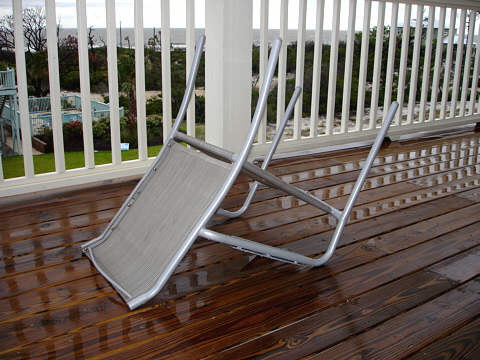
Glenn and I are in Cape San Blas, Florida on vacation enduring the "wrath" of Tropical Storm Alberto. We first pass through Dothan, Alabama where we have the possibility of going to a gun show or a peanut festival and then head to our beachhouse near Apalachicola where we have a hurricane warning. Join us for our brief podcast interviewing a local waitress, teens, and some staff at the Piggly Wiggly grocery store about this treacherous "hurricane". If you have been watching CNN weatherpeople with their ponchos and those 3 feet "killer waves"--don't believe the hype--get the real story in our ground breaking podcast. Glenn and I survived the storm but did have to deal with the horrible aftermath --really, see the overturned chair?
To listen to the podcast, click here or you can subscribe via iTunes. If you would like to comment or make a suggestion on this lame--uh, I mean lovely, podcast, leave it below.
Sunday, June 11, 2006
So far, the beach is really beautiful near Cape San Blas, Florida where we are staying except for the limited internet access and cell phone coverage, but I guess most people here want to "get away from it all." Me, I'm an internet addict but having a very nice time swimming in the ocean and watching the waves. There is a "tropical depression" moving in which should be exciting--maybe not exactly Katrina but if it gets exciting, Glenn and I will do a podcast from the deck of our beach house, and just ride out the storm, kind of like Shepard Smith--okay, more like the time Dan Rather held onto a palm tree in some storm that seemed to be going nowhere. So far, the weather looks fine, though.
Update: Well, Tropical Storm/or Hurricane Alberto is on the way to the Gulf coast--wish me luck!
Update: Well, Tropical Storm/or Hurricane Alberto is on the way to the Gulf coast--wish me luck!
Saturday, June 10, 2006
Beach Blogging
Well, Glenn and I have escaped to the beach for a while (with internet access, of course). So blogging may consist of boring details of my beach vacation--or maybe pictures or a podcast of anything I can find of interest. Are other people taking vacations this summer? And if so, do you find them relaxing or do they make you more stressed--I say both for me.
Friday, June 9, 2006
Podcast: Divorce Court 101
Statistics indicate that the divorce rate is high--some say up to fifty percent of marriages in the US end in divorce while others say it is lower, but still high. Are you about to become one of these statistics or know someone who is? Then you have to listen to our dicussion with divorce attorney, Lauren Strange-Boston, who joins us in our studio today to discuss how men and women differ when it comes to negotiating the terms of divorce. We will focus first on what to look for in a spouse in order to avoid divorce, how to find a good divorce attorney if the worst happens and you need one, how to manage your feelings in the most effective way (hint: anger and/or manipulation may not win your case), and what to do if your soon-to-be ex decides to bring charges against you for sexual abuse or other serious allegations.
You can listen to the podcast by clicking here (no iPod necessary) or you can subscribe via iTunes here. Here is a link to our podcast archive if you want to listen to previous podcasts here. And there's a low-fi version for dialup users right here.
Please leave any comments or suggestions below
You can listen to the podcast by clicking here (no iPod necessary) or you can subscribe via iTunes here. Here is a link to our podcast archive if you want to listen to previous podcasts here. And there's a low-fi version for dialup users right here.
Please leave any comments or suggestions below
Thursday, June 8, 2006
Women's Confidence Day
Apparently, yesterday was declared Women's Confidence Day by Queen Latifah and other women who feel the need to continue the tired program of promoting women's self-esteem (Thanks Allah Pundit). Haven't we drilled into most women's heads enough self-esteem already? Has anyone ever asked whether or not this "self-esteem" is helpful to women and society or not? Pumping women up with fake programs and phony self-esteem seems to do more harm than good--hence the need for books like See Jane Hit : Why Girls Are Growing More Violent and What We Can Do About It. It seems that we would spend our time more wisely by teaching women how to actually master real skills such as mathematics, science and engineering then promoting programs that provide a fake, but worthless sense of self. "Radiating confidence" can never substitute for real knowledge and plain hard work.
It seems that we would spend our time more wisely by teaching women how to actually master real skills such as mathematics, science and engineering then promoting programs that provide a fake, but worthless sense of self. "Radiating confidence" can never substitute for real knowledge and plain hard work.
Wednesday, June 7, 2006
Should We Have a Fat Tax?
Dave at the Crisper has an interesting post on the possibility of taxing those with a high BMI (Body Mass Index). Should we also consider a tax on crappy genetics or how about just plain bad luck? Because hey, my BMI is 20 and I'm not doing so good in the health department. Could it just be that some people find fat people offensive? I wonder how far the food Nazis are willing to go so that they do not have to bear the unsightliness of the overweight?
Sunday, June 4, 2006
Podcast on Parenting
Today, we are talking with fellow bloggers, James Lileks and Cathy Seipp, on how parenting has changed over the last thirty or so years. Lileks is the author of Mommy Knows Worst : Highlights from the Golden Age of Bad Parenting Advice,
 which is a hilarious book about the bad parenting advice from the 1940's and 1950's. You can see a review of his book by me here at TCS Daily. Seipp is a columnist at the LA Times and blogger at Cathy's World. She has some interesting ideas about parenting that she shares with us.
You can listen to the podcast here or you can subscribe to us on iTunes by clicking here.
There is an archive of past podcasts here. And there's a lo-fi version for dialup here.
Please leave comments or suggestions below.
Carnival of the Insanities
The Carnival of the Insanities is up at Dr. Sanity's blog. Take at look at number 17--who knew that video games were good for you? Frankly, they never seemed that bad for kids to me.
Friday, June 2, 2006
First Carnival of PsychBloggers
The first Carnival of PsychBloggers is up at OK, I'm Not Really a Cowboy Blog. Go check it out. He also needs crack money according to his donation button. If he's going into the field of psych, it's probably best to support this unfortunate habit-- he'll need all the crack he can get.
Thursday, June 1, 2006
Podcast with Peter Beinart

Today we are speaking to Peter Beinart, who is the author of a new book, The Good Fight : Why Liberals---and Only Liberals---Can Win the War on Terror and Make America Great Again.
 Mr. Beinart is editor at large of The New Republic, a regular writer for Time and a television commentator. He talks with us about his new book, why Democrats are "too nice" to each other, and why only liberals can win the War on Terror. Glenn and I discuss our reaction afterwards and my only conclusion: When a liberal talks about defending America, it's called a "Good Fight" and when a conservative does, it's called imperialism. Read the book and judge for yourself.
 You can listen to the podcast by clicking here or subscribe on iTunes, which we would appreciate. (It moves us up on the charts.) You can see our podcast archive of other shows here, and there's a dialup version right here.
Please leave any comments or suggestions below.
More on Marriage
Is marriage in the US on the rocks like it is in Britain? Apparently, the changing views on marriage are not going to stop the British legal system from stepping in to further control interpersonal behavior as those who are living together will now be subject to similar "rights" of those who are married--and finally, now gay couples will be included in the screw job--I mean rights--that we heterosexuals have suffered with--I mean "benefited" from, for years. (Hat Tip: Hot Air)
BTW, I am not talking about the interpersonal relationship of marriage as a "screw job"--a wonderful relationship is the ultimate reason for marriage, I merely mean that unfair laws regarding marriage can sometimes be a "screw-job."
BTW, I am not talking about the interpersonal relationship of marriage as a "screw job"--a wonderful relationship is the ultimate reason for marriage, I merely mean that unfair laws regarding marriage can sometimes be a "screw-job."
Subscribe to:
Comments (Atom)